Short thoughts on recent tech news...RIM as Greek tragedyI wrote last fall that I was worried about RIM's financial stability (
link), but I never expected the company to start inflicting damage on itself. RIM has always come across as a calm, dependable company. Maybe not as flashy as some other firms, but reliable and smart. But as we approached the PlayBook launch, the company has started to look like its own worst enemy.
It's clear that the PlayBook was designed initially as a companion device for people who have BlackBerry phones, and only those people. That's an interesting choice -- not one I would have made, but I can see RIM's logic. But apparently RIM decided late in the game that it needed to market the tablet to a broader range of customers. It started talking up the features those users would need, without making clear that the features would not be included in the device at launch. Many of the things the company has been touting -- such as Android app compatibility and the ability to check e-mail messages independently of a BlackBerry -- were not available when the device shipped. RIM has been marketing vaporware. That guarantees disappointed reviews that focus on what the device doesn't do, rather than what it does. Check out Walt Mossberg's write-up (
link).
While this has been going on, RIM co-CEO Mike Lazaridis has been compounding the problem by creating a personal reputation as a loose cannon. His latest escapade was ending a TV interview with BBC when they asked about security issues. The use of the word "security" was mildly provocative, but if you've ever dealt with the British press, you know they specialize in goading people to get an interesting reaction. The more senior your title, the more they'll poke at you, to see if you can take the heat.
The way this game works, there are several techniques you can use to deal with an aggressive question. You can laugh at it, you can calmly point out the flaw in the question, you can answer it earnestly and patiently, and you can even pretend not to understand it (I did that once on a UK TV show and it drove the interviewer crazy because he didn't have time to rephrase the question). But the one thing you can't do is stop the interview. If you do that, the BBC will post a clip of you online that makes you look like a gimlet-eyed prima donna (
link).
The fact that Lazaridis did this means either he's losing personal control under pressure, or not being properly briefed by his press people, or both. Whatever the cause, it is unprofessional, and it's making RIM's challenges harder.
If you want to understand the damage being done, you can read the forward-looking obituary of RIM that Slate just ran (
link). Or check out this column by Rob Pegoraro of the Washington Post (
link). Rob's a very fair-minded, professional journalist who isn't given to hyperbole. But he called Lazaridis' actions "profoundly foolish from any sane marketing perspective...Seriously, does RIM not realize whom it’s competing with? The company is all but begging to get crushed by Apple."
I haven't written off RIM by any means. They have a huge customer base, a great brand, and a long history of overcoming skepticism from people like me. I hope they can do it again. But at a minimum, RIM's management needs to recognize that they do not have the marketing skills needed to play in the world of increased smartphone competition. They need professional help, immediately. And I worry that the marketing problems are actually symptoms of much deeper disorder within the company.
The lamest market research study of the yearIt's still early in the year, but I think someone's going to have to work pretty hard to do a lamer market research study than Harris Interactive's EquiTrends survey of mobile phone brands in the US. Harris says the survey indicated that Motorola has the most "brand equity" of mobile phone brands in the US, followed by HTC, Sony Ericsson, Nokia, and Apple. Harris also provided a nice chart of the results (
link):
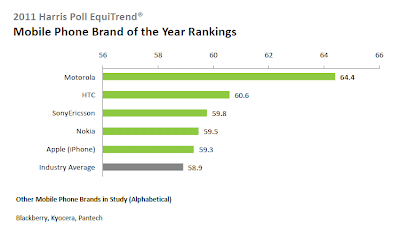
There are a couple of problems here. The first is that the reportedly best-selling mobile phone brand in the US, Samsung, was not included in the results (
link). Oops.
The second problem is that Harris doesn't directly measure brand equity (which is a pretty fuzzy concept anyway). What it measures is "Familiarity, Quality, and Purchase Consideration." Those three ratings were combined into an overall brand equity score.
So this is a made-up rating created through a mathematical formula that Harris hasn't shared with the public, as far as I can tell. But Harris assures us that it's meaningful: "Those companies with high brand equity are able to avoid switching behaviors of those brands that lack brand equity." (
link). So, according to Harris's research, people in the US should be switching from other phone brands to Motorola.
But in the real world, the exact opposite has been happening. Motorola has been losing share. The number three rated brand, Sony Ericsson, has barely any distribution in the US, so it doesn't have much share to lose. The number four brand, Nokia, has lost most of its US share.
Harris argues that Apple's mediocre score is driven by the sophistication of the iPhone: "There is still a large audience of consumers that aren’t interested in a smartphone running their life, and Apple doesn’t have a product to meet that need." I think that's correct, but HTC also sells only smartphones, and it was ranked number two.
And oh by the way, what's the margin of error in Harris's survey? I can't find it disclosed anywhere, but my guess is that it's several points plus or minus, in which case everyone except Motorola is in a statistical tie. That wouldn't have made for a cool looking marketing chart, though.
It's been distressing to see websites pick up the Harris story and repeat it without questioning the results. PC Magazine swallowed it whole (
link), as did MocoNews (
link). A lot of other sites reprinted the Harris press release verbatim. Even if you didn't dig into the flaws, the study ought to fail the basic sniff test of credibility -- does anyone
really believe that HTC has a stronger brand in the US than Apple?
When I worked at Apple and Palm, we hated synthetic brand rating studies like this one (and the JD Power ratings, which are similar) because the results depend more on the secret formula used by the polling company than on the actual behavior of customers. The polling companies construct these special methodologies because they can then sell long reports to the companies surveyed explaining the results, and also charge the winners for the right to quote the results in their marketing. Check out the fine print at the bottom of the Harris press release: "The EquiTrend® study results disclosed in this release may not be used for advertising, marketing or promotional purposes without the prior written consent of Harris Interactive." I don't know for sure that Harris charges to quote the survey, but that's the usual procedure.
The lesson for all of us is that you should never accept any market research study without looking into its background, even if it comes from a famous research company.
Ebooks: Here comes the tipping pointThe continued strong sales of iPad, Kindle, and Nook in the US are bringing us steadily closer to the tipping point where it will pay an author to bypass paper publishing and sell direct to ebooks. The latest evidence is from the Association of American Publishers, which reported that ebooks made up 27% of all book revenue in the US in January-February 2011 (
link). AAP correctly pointed out that the ebooks share was raised temporarily by people buying ebooks to read on all of the e-readers they got for Christmas. The share will go down later in the year.
Still, at any share over about 20%, it will be more economical for an established author to self-publish through ebooks (where they can retain 70% of sales revenue) rather than working through a paper publisher (where they get at most 15% of revenue). When we hit that point on a sustained basis, I expect that a lot of authors will move to electronic publishing quickly.
It looks like we'll hit that point sometime this year or next.
Flip aftershocksSilicon Valley has the attention span of a toddler in a candy store, but it was interesting to see how people around here lingered on the story of Flip's demise several days after the announcement. There were dark suggestions of ulterior motives at Cisco -- that they had bought the company to strip it of its intellectual property (
link) or that they shut it down a viable company only so they could look decisive to Wall Street (
link). And that was just the stuff in the press. I've heard even more pointed speculation from people working in Silicon Valley.
My guess is the real story is a lot more complicated and nuanced, but at this point it doesn't matter. Killing Flip may have helped Cisco with Wall Street analysts, but the sequence of buying Flip and then shutting it down has seriously damaged the company's image in Silicon Valley as a leader and a partner. Silicon Valley is a very forgiving place. You can make huge strategic mistakes, and waste billions of dollars, and still you'll be forgiven as long as you did it in sincere pursuit of a reasonable business idea. But Cisco's senior management is now viewed as either overconfident to the point of stupidity, or as the deliberate torture-murderer of a beloved consumer brand. I've rarely seen this level of hostility toward a management team, and I don't think they will be forgiven anytime soon, if ever.
Does that have any practical impact on Cisco's business? Not immediately; business is business. But it will probably be a little harder for Cisco to make alliances and hire ambitious people in the future.
Google 2011 = Microsoft 2000?It's spooky how Google is sometimes starting to remind me of Microsoft circa 2000.
The latest incident was a quote from a Google executive saying that the company wants iPhone to grow because Google makes a lot of money from it (
link). Microsoft used to say the same sort of thing about Apple, claiming that it made more when a Mac was sold rather than a Windows PC (
link). (The idea was that many Microsoft apps were bundled with Windows at low cost, whereas Mac customers bought Microsoft apps at retail.)
In both cases, the statements may be technically true, but what they really point out is that the company has deep internal conflicts between its various business units. Yes, part of Microsoft wanted to make Macintosh successful, but another part of Microsoft wanted to kill Macintosh. Microsoft as a whole wanted to do both at the same time, which created internal confusion. Add in antitrust lawsuits by governments and Wall Street pressure for quarterly growth, and Microsoft quickly became distracted, inwardly focused, and slow-moving.
Parts of Google, I'm sure, think iPhone is great and want it to grow. But I guarantee that the Android team is trying to kill iPhone (and Nokia, and HP/Palm). Google has its own set of government distractions, plus a big old lawsuit from Oracle, plus legal action by Microsoft and Apple against Android licensees.
There are huge differences between Google and Microsoft, of course. Google is not under the same sort of Wall Street pressure that was applied to Microsoft, and Google's founders have not lost interest in running the company.
But it's disturbing to see how quickly some of Microsoft's symptoms are showing up at Google.
Hey Nokia, how do you define "primary"?Microsoft and Nokia said they have finalized the contract for their alliance. There were a couple of interesting tidbits in the announcement:
--Both companies said they completed the negotiations sooner than they expected. Usually that sort of statement is hype, but for an agreement of this size, it actually was a pretty fast turnaround.
--They went out of their way to say that Nokia will be paying royalties for Windows Phone similar to what other companies pay. That's important legally and for regulators, so companies like Samsung can't complain that Microsoft is giving discriminatory pricing. At the same time, the announcement also made it clear that Microsoft will be passing a ton of money to Nokia for various services and IP, which Nokia wanted on the record to help with its investors. I think the net effect will be that Nokia gets a free Windows Phone license for a long time. That will not please Samsung, HTC, and the other Windows Phone licensees, because it puts them as a price disadvantage.
--The companies are apparently cross-licensing a lot of patents. I wonder if this will help Nokia with its IP warfare against Apple.
--In an interview with AllThingsD (
link), Microsoft and
Google Nokia said Windows Phone was Nokia's "primary smartphone operating system." That leaves open the door for Nokia to play with other smartphone operating systems, and it leaves completely unanswered the question of tablets. I'm sure the Symbian/Meego fans will be all over that as a ray of hope for their platforms, but to me it just leaves some prudent wiggle room for Nokia in the future. I'd love to know how the agreement defines the words "smartphone" and "primary" -- or if it even has definitions for them.
(Note: Edited on April 22 to fix an embarrassing typo.)


