Senin, 15 Agustus 2011

PPD 498 Fall Syllabus

PPD 498: Senior Honors Seminar in Policy, Planning and Development
University of Southern California
Professor Richard K. Green
richarkg@usc.edu
Keynesian.richard@gmail.com
213-740-4093

This is a senior honors course on topics in Urban Development. This emphasis of the course is on reading, presenting and critically reviewing some classics, old and new, on issues important to those who wish to do research on cities and their regions.

The requirements of the course are three:
(1) Doing the reading before class and participating in class. Your performance in participating will determine 1/3 of your grade.

(2) Leading a ½ hour class discussion on a reading of your choice. You will need to get clearance from me on the reading, and you must let me know your proposed reading by October 1, 2010. This will determine another 1/3 of your grade.

(3) A critical literature review of a topic of interest to you involving an urban topic. The lit review must discuss a minimum of five papers (more would be better) and should be 15-20 double spaced, 12-font, pages long. This will determine the final 1/3 of your grade.

All of USC’s academic conduct rules apply to this course; because you are choosing to be in it, I am assuming this will not be an issue with any of you.

Topics and Readings
August 25 Lenses of Social Science
George Orwell, Why I write.

September 1 New York
Jane Jacobs, The Death and Life of Great American Cities I

September 8 Growth in Cities
Jane Jacobs, The Death and Life of Great American Cities II
John Quigley (1998) Urban Diversity and Economic Growth, Journal of Economic Perspectives, 12(2):127-38.

September 15 Urbanization and Development
J. Vernon Henderson (2004), Urbanization and Growth, Brown University Working Paper
Marianne Fay and Charlotte Opal (1999), Urbanization without Growth, World Bank Research Working Paper.

September 22 Sprawl
Reid Ewing (1997), Is Los Angeles-Style Sprawl Desirable? Journal of the American Planning Association, 63:1, 107-126.
Peter Gordon and Harry Richardson (1997) Are Compact Cities a Desirable Planning Goal? Journal of the American Planning Association, 63:1, 95-106.
George Galster, Royce Hansen, Michael Ratcliffe, Harold Wolman, Stephen Coleman and Jason Freihage (2001), Wrestling Sprawl to the Ground, Housing Policy Debate, 12(4), 681-717.

September 29 Anti-Sprawl
Ed Glaeser, The Triumph of the City I

October 6 Agglomeration
Ed Glaeser, The Triumph of the City II
Paul Krugman, Development, Geography and Economic Theory

October 13 Guest

October 20 Housing
Stephen Malpezzi (1996) , Housing Prices, Externalities and Regulation in US Metropolitan Areas, Journal of Housing Research, 7(2) 209-242.
Richard K. Green (1996), Should the Stagnant Homeownership Rate be a Source of Concern, Regional Science and Urban Economics.

October 27 Cities and Health
Charles Rosenberg, The Cholera Years.

November 3
William Cronon, Nature’s Metropolis I

November 10
William Cronon, Nature’s Metropolis II

November 17
Student Led Discussions I

December 1
Student Led Discussions II

Minggu, 14 Agustus 2011

Current Construction of the New World Trade Center Site

Around 8.3 million square feet of space is currently under construction at the World Trade Center Site.  To put this in context, downtown St. Louis and downtown Milwaukee both have a total of 11 million square feet of office space, so New York is building the equivalent of a medium city downtown in less than 5 years.

Is this too much building?  Perhaps not.  The other contextual number is the amount of current space in Manhattan; the total is about 350 million square feet.  So by building a downtown St. Louis, Manhattan is expanding its office market by only two to three percent.  

Jeremy Stein for Fed Governor

Mark Thoma writes that the administration is considering nominating Richard Clarida and Jeremy Stein for the Federal Reserver Board. He cites an encouraging Clarida speech, but writes, "I know less about Stein, so I'll withhold judgment for the moment."

Personally, I am a big fan of Stein's work. The shortest way to explain why is to list the titles of his five most cited papers:


  • Herd Behavior and Investment

  • A Unified Theory of Underreaction, Momentum Trading and Overreaction in Asset Markets

  • Rick Management: Coordinating Investment and Financing Policies

  • Bad News Travels Slowly: Size, Analyst Coverage and the Profitability of Momentum Strategies

  • Internal Capital Markets and the Competition for Corporate Resources.


Stein has spent his career trying to figure out how capital markets really work instead of pledging fealty to models that don't work very well.  I can't think of a better intellectual qualification for a Federal Reserve Board member.

Jumat, 12 Agustus 2011

William Malkasian

My boss from 1987-1990, while I was finishing my dissertation and before I became an assistant professor, was Bill Malkasian. Bill introduced me to the world of real estate, and for that I will be ever grateful.

When I think of the people in the world who have taught me a lot, only members of my family supersede Bill. He helped me learn, in the phrase of Paul Krugman, how to "listen to the gentiles." He also helped make me a more sympathetic person, and allowed me to appreciate skills in others that I would otherwise have not appreciated.

Bill is leaving his position as president of the Wisconsin Realtors Association after more than 30 years in order to provide strategic planning consulting to real estate groups around the country (Bill also taught me the value of strategic planning). WRA will miss him a lot, but the rest of the country will be better off.


Kamis, 11 Agustus 2011

DOES HAVING TWO CO-CEOS WORK FOR A COMPANY?

HOW GOOD IS A CO-CEO FOR A COMPANY’S SALES, PROFITS, MARKETSHARE, AND SHAREHOLDERS? I FOUND OUT THE ANSWERS, AND WASN’T AT ALL SURPRISED...


In the weeks that followed the first signs of infertility in the US home mortgage market in the new century, panic gripped boardrooms in America Inc. According to the US Government’s Department of Commerce, these dates correspond to the Aug-Sept months of Q3, 2008. Then, the shock was expected, accepted and came with reasons. [Till Q3, 2009, the US economy continued going downhill with GDP growth recorded in the four quarters leading to Q3, 2009: -2.7%, -5.4%, -6.4% and -0.7%]. Corporations which till then had been a symbol of America shining, had fear in their minds – they wanted to avoid losing the pounds gained since 2001. And those who had been doing quite the opposite, sensed a threat to their very existence. One of them was Motorola.


CEOs

(L-R, starting opposite page): Sanjay Jha (CEO, Motorola Mobility Solutions) & David Brown (CEO, Motorola Solutions) – co-CEOs whose roles and divisions were split after an initial failed start; Anshu Jain & Jurgen Fitschen (Co-CEOs of Deutsche Bank) – an unwelcoming reaction from the stock market on their appointments; and Mike Lazaridis & Jim Balsillie (co-CEOs of the troubled Research-In-Motion) – who will go first?


Motorola then, had become a shadow of its glorious past. Between 1994 and mid- 2008, Motorola’s global market share in the mobility devices market had plummeted from 45% to 9.5% (Gartner). The company had clearly missed the leap from analog to digital. It failed to introduce digital phones, missed out on customer interests when their attention turned towards more software-than-hardware handsets, and its plodding culture and bureaucracy within the ranks resulted in non-exciting launches in the decades leading to 2008 (except for the RazR). At the company – largely regarded as a victim of innovator’s dilemma – cancellation of projects and firing became the order of the day. Finally, after having lost 76.29% of its m-cap since Jan 2000 (from $109.14 billion on Jan 2, 2000 to $25.88 billion on Aug 3, 2008), on Aug 4, 2008, it planned a boardroom surgery. Two men were chosen to rule the fast-disappearing island kingdom and better what Edward Zander had tried with the RazR launch. Sanjay Jha and Greg Brown were the two co-CEOs. The move backfired.


Since Motorola became a victim to the co-CEO leadership practice, its decline accelerated. Until Q4, 2010, the company’s share in the worldwide mobile market – despite an 888.8% rise in sales of Android handsets (which was Motorola’s bet) – had fallen to 2.1%. And how did the co-CEOs do worse for the company than the much criticised authoritarian-andbureaucracy- promoting CEO Zander? While under Zander (between Jan 2004 and Jan 2008), the company had gained 1.2% in market share (to touch 17.5% for Q4, 2007), with its m-cap too appreciating by 24.0% to touch $39.01 billion (as on Dec 31, 2007), under the two co- CEOs, within just a year-and-a-half (between Q3, 2008 and Q4, 2010), the company besides losing 7.4% of the global market share, eroded more than half (55.56%) of their shareholders’ wealth – to touch a lowly $9.26 billion as on December 31, 2010. While everyone – from a near-dead HTC to the ever declining Nokia – moved ever so swiftly to capture opportunities in the 4G market, Motorola, under the duo remained every so dedicated to its engineering and careful to market culture [rather, slow – proof is the delayed launches of its Droid Bionic and Xoom 4G update]. This co-CEO arrangement suffered from delays in decision- making. In an interview with BusinessWeek, Jha had confessed that he takes about “90 days to assess a situation before taking any final decision.” Naturally, much time is spent in convincing the other co-CEO – Brown. 90 days to take any call in the world of mobility beats any logic. The Economist, in a Mar 2010 piece titled, ‘The Trouble with Tandems’, puts the problem with co-CEOs theory rightly: “Joint stewardships are all too often a recipe for chaos. Rather than allowing companies to get the best from both bosses, they trigger damaging internal power struggles as each jockeys for the upper hand. Having two people in charge can also make it tougher for boards to hold either to account. At the very least, firms end up footing the bill for two CEO-sized pay packets.”


Stock Movement of Motorola

The shareholders at Motorola (led by Carl Icahn), having finally realised that this joint-leadership is doing no good to them, split Motorola into two separate companies in Jan 4, 2011 – Motorola Solutions (headed by CEO Brown) and Motorola Mobility Holdings (headed by CEO Jha). Going by the financials during the two bygone quarters, it appears that both the companies are en route to safety. After losing $4.29 billion in FY2008 & FY2009, within seven months of the split in roles, it is quite visible that the move is working – the combined net m-cap of the two firms have reached $19.92 billion (a rise of 115.12%), and the two companies have also become more profitable (with a 206.93% y-o-y increase in PAT for H1, FY2011 to touch $709 million). Motorola invented the 6-sigma more than two decades back. It can’t have two CEOs in the name of ensuring quality, and missing out on timely meeting consumer demands. One CEO on top will do.


Stock Movement of RIM

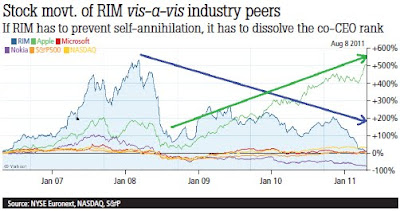
Trouble in cases where joint bosses are calling the shots, is not rare. The most recent instance being that of RIM which is led by co-Chairmen and co-CEOs Mike Lazaridis and Jim Balsillie. While Balsillie is the techie, Lazaridis is the salesguy. This combination was supposed to bring out the best in RIM. It has not. Considered to be amongst the biggest threats to Apple and Nokia, RIM’s co-CEOs structure has succeeded, but only so far as to please its small target audience with handsets that lack variety. Three years back, RIM’s mcap stood at an all-time high of $73.47 billion (Q2, FY2008). Since then, RIM has lost 84.14% in m-cap and is today, worth only $11.65 billion. In fact, over just the last five months, with delays in the launch of its tablet Playbook (and the poor reviews) the company’s share price has fallen by 65.5%. RIM in Q1, 2011, lost 5.1% of its global market share y-o-y (which fell to 14%). On the other hand, Apple (rise of 3% to 18.7%), Samsung (+6.5%; 10.8%), and even HTC (+4%; 8.9%) grew their respective pies. And the future? Both IDC and Gartner have bad news for RIM, whose market share is forecasted to fall to a lower 13% by 2015. For others, the picture is pretty. Android (43.8%), Apple iOS (19.9%), the Nokiasaviour Windows Phone 7 (20.3%) are set to rise further. So where lies the rub? Industry experts claim that RIM is not making a bad product. It is only that the company is not delivering what customers want to pay for. And this is where the two co-CEOs are finding hard to match their thoughts. Lazaridis would prefer selling something unique and mass-pleasing, while Balsillie does not seem too confident about RIM representing simple technology. A case in point of this company making a product unnecessarily complicated is the Playbook tablet. Why on earth would any user want to link his tablet to his smartphone to even send an email? Again, time is lost, and the worst case scenario is right in front of the world. Smartphones with no innovation, tablets that are not selling for the right reason (at present, what RIM is selling is a half-baked tablet, on which there is no email app, no calendars, no notes app et al), and two co-CEOs whose performance cannot be questioned as they are also the co-Chairmen of the Board of Directors of RIM. Balsillie should step down and perhaps assume the role of the CTO and Laziridis should continueas the sole CEO and not allow geeks to force him to sell engineering feats that do not help win customers’ dollars. What RIM needs to do fast is to make rapid, incremental alterations to its hardware, software, and platform products. If it does not, it only risks giving up the high-end status cult-crown, and will over time, slip in the priority lists of carriers, and witness a constant fall in margins. Remember: Palm was also once a smartphone leader, but is today, almost nowhere on the charts. RIM can become the second Palm. Balsillie cannot even blame any lack in R&D dollars for not getting his products right. Warren Buffett once wrote in one of his book titled, ‘On the Interpretation of Financial Statements’, that, “If a company has to spend more than a certain percentage of its gross profit on R&D, its competitive advantage cannot be sustained...” According to him, that percentage is 15%. RIM spent 15.86% of its gross profits in R&D last year (FY2010-11). See where the problem is? The geek co-CEO is burning cash, while the salesguy co-CEO is only getting complex stones to sell! Summing up the solution, Rick Wartzman, Executive Director of the Drucker Institute at California- based Claremont Graduate University writes in a BusinessWeek article titled, ‘RIM’s Prickly Board Problem’, “Some governance experts have long suggested that a good way to foster the kind of independence Drucker advocated is to have one individual acting only as CEO and another individual acting strictly as Chairman of the board. Indeed, over the past 25 years, the trend toward dividing these jobs has accelerated, so that 40% of S&P 500 companies now follow this practice. With RIM having had trouble launching new products, its profit forecast dwindling, and layoffs mounting, the board needs to demonstrate that it understands management’s performance is nothing to phone home about.” Strange – in case of Apple, the exit of its CEO is considered a danger to the company. In RIM’s case, the opposite is true!


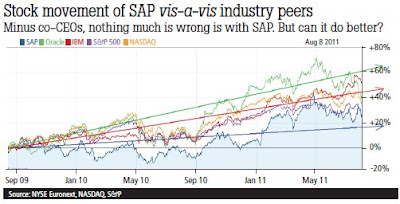
Other creaky seesaws with two co- CEOs promoting organisational paralysis can be seen too. Bill McDermott and JimHagemann Snabe who have been co- CEOs of SAP, since February 7, 2010, have actually been leading the least-attractive outfit in enterprise solutions business for shareholders. Even in a growing enterprise solutions market (especially after recovery started post-2010), since they took charge of SAP, the company has lost 1.93% in m-cap. In fact, during the very next session of trade post announcement that the duo would take charge of SAP, the stock grew slimmer by 5.82%. To make a quick comparison, since Feb 2010, SAP’s competitors, led by single bosses who can hardly be described as consultative or the sharing types, have done better. While tyrant- Larry Elisson’s Oracle produced a return of 13.77% during the past 17 months, the salesguy-Sam Palmisano’s IBM increased his investor’s money by 40.44%!


Stock Movement of SAP

It was the two co-Chairmen and co- CEOs Michael Klein and Tom Maheras of Citi Markets & Banking (Citi’s investment banking arm) who led the division to becoming the highest contributor to the bank’s total losses of $29.38 billion in FY2008 & 2009. When Anshu Jain was crowned co-Chairman and co-CEO of Germany’s largest bank (Deutsche Bank; alongisde Jurgen Fitschen) the stock market reacted negatively – one trading session after the announcement on Jul 26, 2011, the stock was down 3.31% to $53.77. Nine trading sessions later (Aug 8, 2011), it had shed 21.86% (at $43.41). Why such a stigma attached to co-CEOs? History is proof. Whether it be MySpace’s Jones and Hirschhorn or Wipro’s Paranjpe and Vaswani or Martha Stewart Living Omnimedia’s Millard and Marino, co-CEOs have always failed the litmus test. And quite spectacularly so. Either the company has suffered or they have been replaced (and the company still suffers!). These outcomes are summarised well by a 2010 paper titled, ‘Shared leadership: Is it time for a change’, in which Dr. Michael Kocolowski of South Florida University writes, “We are dealing with a universal myth: in the popular mind, leadership is always singular. A shared leadership issue to consider involves decision making. Since it is sometimes difficult for a more than one leader to reach consensus, decisions can take longer to make. The benefits of complementary leadership are negated when agreement about organisational priorities differ and irreconcilable differences impede decision making and forward progress.”


When the 20-feet long, 2 tonne-weighing Stegosaurus (a dinosaur that lived in the Woodlands of western North America) was first discovered in 1877, scientists were foreign to the idea of living beings with gigantic lizards & walnut-sized brains. Therefore, a palaeontologist named Othniel Marsh put forward his claim that a second brain resided in the Stegosaurus’ backside, which helped him control the back and lower part of its body. Debates continued over this extinct being that walked the Earth, 150 million years ago. But there is one lesson which this Jurassic Park-page has for today’s board of gigantic organisations that fear extinction: the second brain wherever in the body didn’t quite help Stegogaur’s fate? And it doesn’t seem to be working too well in the modern world either. There can be only one emperor to the empire. There should be only one leader in the corporation!

Anti-stimulus

The Government Component of the  National Income and Product Accounts for the past 6 quarters (QI 2010 through Q2 2011):


21Government consumption expenditures
    and gross investment
-1.23.71.0-2.8-5.9-1.1
22   Federal2.88.83.2-3.0-9.42.2
23      National defense0.56.05.7-5.9-12.67.3
24      Nondefense7.814.7-1.83.1-2.7-7.3
25   State and local-3.90.4-0.5-2.7-3.4-3.4
Anyone see a problem here? It's not like we have seen a rip-roaring "crowding-in" of the private sector. For those who think we should cut government spending, well, we are, and more is to come thanks to the debt-ceiling deal. I hope I am wrong about this, but it is hard to see how this leads to a recovery in jobs any time soon.

Rabu, 10 Agustus 2011

The Case for Software Patents

It's become popular lately to call for the elimination of software patents.  Tim Lee at Forbes sounded the call last month (link), and this week Mark Cuban joined the chorus (link):
"Because of software and process patents any company could be sued for almost anything. It is impossible to know what the next patent to be issued will be and whether or not your company will be at complete risk. It is impossible to go through the entire catalog of patents issued over the last 10, 15, 20 years and determine which will be used to initiate a suit against your company."

I have a ton of respect for many of the people arguing against software patents, but I disagree strongly with their arguments.  I think software patents play an important role in encouraging innovation, especially by small companies.  The loss of them would make it harder for small companies to survive, and would discourage fundamental innovation in software.

The online debate about software patents is very contentious, and much of it focuses on philosophical issues like the nature of software and whether that's inherently patentable.  The debate also often gets mixed with the contention that all software should be free.  I'm not going to get into either topic; the arguments are arcane, sometimes quasi-religious in their fervor, and besides they've already been debated to death online. 

What I want to focus on is the broader issue of the economic role of patents and how that applies to software.  The patent system is designed to encourage innovation by giving a creator a temporary monopoly on the use of an invention.  Does that mechanism work in software?  What are the problems?  And what's the best way to fix them?

When you take that perspective, I think it's clear that there are some genuine problems with software patents.  (Actually, there are problems with patents in general, and software is just the most prominent example.)  But I think there are better ways than a ban to solve those problems.  To me, banning software patents to solve patent problems would be like banning automobiles to stop car theft.  The cure is far worse than the disease.


The value of software patents

Let me start with a personal example.  As I've mentioned before, I'm working on a startup.  When we brief people on what we're doing, one of the first questions we get is, "how will you prevent [Google / Apple / Microsoft / insert hot web company here] from copying you?"

A big part of the answer is, "we've filed for a patent."

A patent isn't magic protection, of course.  It might not be granted, and even if it's granted, patents are difficult to enforce against a really big company.  But it reassures investors, and more importantly if a Facebook or Google wanted to copy our work, the patent makes it safer and quicker for them to buy our company rather than just ripping us off.  So it helps to protect the value of our company.

Without the patent, I think it could be open season on us the moment we announce our product.

Advocates of eliminating software patents say there are other ways to protect software companies.  The first is that software can be copyrighted.  That's technically true, but the only thing copyright protects you from is word for word theft of your source code; it does not protect inventions.  For most software innovations, copyright is no protection at all. 

The second argument is that small companies should move quickly, so the big companies can't catch up with them.  The idea is that if you move fast enough, you won't need patents.  I think there's a consumer web app bias in that advice -- it works best for small apps that can be adopted quickly, or that have a strong social effect (so the user base is part of your competitive protection).  It doesn't work well for software tools that have a slower adoption curve.  The more complex and powerful the software, the slower the adoption cycle.  This is especially true for enterprise tools.  Without patents, those companies are exquisitely vulnerable to being ripped off soon after they launch, when they're just starting to gain word of mouth. 

So for companies creating new categories of software, and especially for enterprise software tools, I think patents remain the best (and really only) protection from theft.

But what about the damage being caused by abuse of the patent system?  If we keep software patents, are we then endorsing those abuses? 

I don't think so.  In the articles I've seen, there are two primary arguments for eliminating software patents: Trolls and patent warfare.  They need to be discussed separately.

Discouraging patent trolls.  The troll problem is something we all know about: patent licensing companies buy large collections of patents and then extort fees from companies that had no idea they were violating the patents.  That's the core of the problem Mark Cuban was talking about above, and it is outrageous.  These surprise lawsuits can have a devastating effect on smaller companies that can't afford to hire a lawyer to defend themselves.  Even if you're in the right, it can be so expensive to defend yourself that you just have to give up and pay the license fee.  That definitely has a chilling effect on innovation, it is contrary to the intent of the patent system, and therefore it needs to be restrained.

But I think the answer in that case is not to eliminate software patents; it's to restrict the right of "non-practicing entities" (patent trolls) to sue for patent infringement.  That would still have a financial effect on small companies -- in the case of my startup, it would make it harder for us to sell our patent if we wanted to.  But patent law exists to protect the process of innovation, not to protect inventors for their own sake.  If you can't put your patent to good use, you aren't contributing to the public good and you shouldn't get the same level of protection as a company that has built a business around a patent.

Patent warfare is a very different issue.  Several large tech companies are using patent lawsuits to slow down competitors and pull revenue out of them.  Eliminating software patents would not stop these wars; they're also based on hardware patents, antitrust law, and any other field of law that the companies can apply.  It's like one of those cartoon fights in a kitchen where a character opens up a drawer and throws everything inside it. 

 
Yeah, like that.

The underlying problem here isn't about patents; it's about the use (and abuse) of the legal system as a competitive tool.  I've had more involvement in tech industry legal wars than I want to think about: I gave depositions in the Apple-Microsoft IP wars, and I testified in Washington in the Microsoft antitrust lawsuit. The overall experience left me plenty cynical about the legal system, but it also persuaded me that big tech companies are perfectly capable of taking care of themselves in court.  They do not need our help.  You should think of lawsuits as just another way that tech companies express love for one-another.

I'm somewhat sympathetic to the Android vendors being sued by Apple, but a lot of it is their own fault.  HTC in particular has no one to blame but itself for its situation, in my opinion.  HTC was one of the first companies in mobile computing, creating PDAs for Compaq and early smartphones for Orange and O2.  I've got to believe that if HTC had been thinking clearly about patents, there are a lot of fundamental mobile inventions it could have patented.  Then it would have had a big enough patent portfolio to force a cross-licensing deal with Apple.

The same thing goes for Google.  When it decided to enter the mobile OS business, it should have expected that it would end up at war with Apple and Microsoft (heck, anyone could have predicted that).  Google should have bought up a big mobile patent portfolio (like maybe Palm's) back when they were inexpensive.

Are we obligated to change the patent laws just because Google and HTC were careless?  No.  Is it in the public interest for us to intervene anyway?  I doubt it.  Here's how the mobile patent wars will play out:  The big boys will do a whole bunch more legal maneuvering, they'll scream bloody murder, and in the end one of them will write a check to the other.  Then they'll all go back to work.

My advice: If it bothers you, stop reading the news stories about it.  Or sit back and enjoy it as theatre.  It's hardly an important enough issue to justify stripping the patent protection from every small software company in the US.


A world without software patents

If you want to understand the importance of software patents, go back and talk to the first people who patented software.  That's what I did.  Two years ago, I corresponded with Martin Goetz, holder of the first software patent (link). 

Goetz was a manager at Applied Data Research, one of the first independent app companies in the 1960s.  ADR made applications for mainframes, and IBM copied and gave away a version of ADR's Autoflow application (the first commercially marketed third party software app).  ADR might have been wiped out, but it had patented Autoflow, and it was able to successfully sue IBM.  That lawsuit, plus a related one by the US government, laid the foundations of the independent software industry by forcing IBM to stop giving away free apps for its mainframes.

The lawsuits involved a lot of legal issues, including antitrust, so you can't say that software patents alone led to the birth of the software industry.  But I think it's clear that patents helped codify the value of software independent from hardware.  If that value hadn't been recognized, the antitrust suit would have been meaningless because there would have been no damages.

So antitrust and patent law have worked together to help protect software innovation.  Antitrust helped to restrain big companies from giving away free competitors to an app (although that protection has eroded lately), while patents restrained big companies from copying apps directly.  It's like a ladder.  If you pull out either leg, I worry that it won't stand.

In his online memoirs (link), Goetz makes the case that application innovation was slow and unresponsive to users in the decade before software patents, and accelerated dramatically in the decade after.  I agree.  That is exactly the sort of innovation that patent law was meant to encourage, and so I view software patents as a success.

Without software patents, I think it would be far too easy to go back to the bad old days when the big computing companies walked all over small software companies, the software industry consisted of only consultants and custom developers, and software innovation moved at a much slower pace.

_____

More reading:  Software entrepreneur and investor Paul Graham wrote a nuanced and detailed take on the subject here.  Some of his conclusions differ a bit from mine, but the essay is well worth reading.