A friend asked me the other day what I thought of Access/PalmSource's recent announcement of the Access Linux Platform (formerly known as Palm OS). I think it's interesting, and there are some hopeful signs. But my main takeaway is that we should probably stop thinking of this thing as the successor to Palm OS, and instead judge it as a new mobile OS based on Linux. Here's why...
When you do a pre-announcement like this, you're usually looking to accomplish a couple of things. You want to make your customers have faith in the future. You want to generate good buzz among the press, analysts, and the online community. And you want to convince possible allies and licensees to work with you. From that standpoint, it looks like the announcement was at least a partial success.
The Linux community is a critical audience for Access/PalmSource right now – one of Access's first goals must be making its mobile Linux the preferred version among the Linux community. Their support will help win licensees. To help make this happen, Access has released some Palm OS code to the open source community, and it has promised to incorporate some Linux standard technology in the new OS.
The reaction on Slashdot wasn't conclusive, but there was a very supportive article on Ars Technica. It said exactly the sot of things you'd like to hear from the Linux community. (If you don't know Ars Technica, it's a very good hangout for technophiles. It often posts much more thorough analyses than most other websites, so it's a very useful resource.)
There were also encouraging noises from parts of the Palm OS developer community. David Beers wrote a nice commentary. David is a prominent Palm OS developer, and although he wants the platform to succeed, he's not at all a fanboy. I'm sure Access wants to hang onto as many Palm OS developers as it can, so posts like this are encouraging.
Analyzing the quotes
One of the traditional elements in a pre-announcement press release is the quotes section, where you get all those stilted quotes from various allied vendors. It usually reads a little like old Soviet propaganda -- and like propaganda you learn more by reading between the lines than you do from the actual quotes.
The game works like this: The company issuing the press release wants quotes from as many prominent companies as possible, and wants the language to be as supportive and specific as possible. The people providing the quotes usually don't want to make too many specific promises, and are often more interested in promoting their own products than in saying anything nice about the actual subject of the press release.
Typically business development people spend a lot of time negotiating these things, down to small details of the quotes.
Access's performance in the quotes game was mixed. The quotes section starts with useful endorsements from LIPS and OSDL, both of which are Linux organizations. I think the placement of these quotes up front shows how much importance Access puts on the Linux community. LIPS (the Linux Phone Standards Forum) consists of France Telecom plus a bunch of Linux and telephony infrastructure companies. OSDL (Open Source Development Labs) is the home of Linus Torvalds and calls itself the center of the Linux community. OSDL's founding members include IBM, Intel, NEC, and HP, so it has a lot of heft. The OSDL quote helps to legitimize Access in the Linux community (I was kind of surprised Access put its quote second on the list).
Wind River was also quoted, which is good because you want the OS to work with standard distributions of Linux. And I was very pleased to see quotes from two mobile operators, NTT DoCoMo in Japan and Telefonica in Europe. Those are very significant because they signal to handset companies that there's a market for devices based on this software.
There are also quotes from several phone component manufacturers – Freescale (formerly Motorola Semiconductor), Intel, Samsung Semiconductor (not the mobile phone group, alas), NEC's semiconductor team, and Texas Instruments. Even though many of the quotes are very noncommittal (basically saying "we like anything involving Linux, and we hear Access is using Linux"), quotes from companies like these are helpful because they reassure potential licensees that a lot of components will be available for phones based on the software.
And there's a quote from Motricity (the parent company of software distributor PalmGear). This seemed strange to me because Motircity doesn't have any direct involvement in the development of the OS. I interpret the quote as a sign that Access was trying to scrape up as many partner quotes as possible.
Who's missing?
There are several glaring omissions from the list of quotes. Before I go into the details, I want to acknowledge that it's easy to read too much into the absence of any particular company from a quotes list. Sometimes there's an innocent explanation – their lawyers didn't like the quote, or an executive who needed to approve it was on vacation. But still, a couple of things stood out to me...
The first is the absence of other operators. Orange in the UK has historically been a strong Treo supporter, and it's owned by France Telecom, which is a member of LIPS. So I was quite surprised that there was no Orange quote. Even more surprising was the absence of any US operators. T-Mobile hasn't ever been warm to Palm OS, and Verizon is very conservative, so I wasn't alarmed that they weren't quoted. But where the heck is Sprint, the original champion of the Treo? And where's Cingular, which has lately been one of the biggest Treo endorsers? I think their absence is not a good sign.
It was also disappointing that neither of the major Chinese phone operators was quoted. Much of the development work on Access Linux is being done in China, and the country is mad for Linux, so you'd think at least one of the operators would be willing to say something positive about the OS.
There's no quote from Monta Vista. That's kind of spooky, since MontaVista and PalmSource had announced plans to work together just last August. I presume the relationship is not going well. I was also disappointed not to see a quote from the CE Linux Forum, an embedded Linux consortium that includes a number of major consumer electronics companies. Access and PalmSource are both members, so you'd think they could have gotten some sort of quote.
But my biggest question was, where are the licensees? Where are Samsung, LG, GSPDA, Garmin, Symbol? Where's Palm? Given all the work that Palm has been doing to reassure its Palm OS-using customers, I was very surprised that there wasn't a quote from them in the press release. It's possible that the licensees didn't want to hint at a pre-announcement of a future product, since that could hurt their current sales. But I'm wondering if there might also be business issues.
Access's announcement said that the new Linux platform will be available to licensees as an SDK (software development kit) by the end of the year. You use the SDK to write applications, but you need the PDK (product development kit) to actually develop a device. As far as I know, Access hasn't even given a public date for the PDK, other than to say that it'll be after the SDK. Unless there's some sort of special pre-availability release to certain licensees, or Access is sand-bagging the date, we're going to see a very long runway until devices are released with the new OS. Palm typically takes a year or more to build an OS into a new device (much of the delay is because they have to rework their proprietary PIM apps to run with the new OS). That might mean you wouldn't see a Treo based on the new OS until late 2007 or maybe even spring of 2008. Perhaps an Asian phone vendor could ship something sooner, but I think you'd still be looking pretty late in 2007.
That's not a life-threatening disaster for Access, since they have deep pockets and can take the time to get the product right. But I think it might be a very significant business problem for Palm. Most of the carriers are now heavily into their migration to 3G. Even six months ago, they were very reluctant to consider adding any non-3G products to their smartphone product lines. There are strong rumors of a Treo 700p, running on Sprint's EVDO 3G network, to ship this summer. I can see that happening since Palm traditionally did its own work to adapt Palm OS to Sprint and Verizon's networks. But I don't know if Palm has the capability to adapt the current version of Palm OS to work with the UMTS 3G standard used by the world's GSM operators. If not, Palm might not be able to ship a Palm OS compatible Treo on 3G GSM networks until the end of 2007. That would have a huge impact on potential Treo sales in Europe, Africa, parts of Asia, and parts of the US.
Some people have speculated online that Palm may be planning to move completely to Windows Mobile. I doubt that's their intent, but given the strong demand for 3G among GSM operators, Palm may not have a choice but to put a lot more investment against Windows Mobile, since it's compatible with UMTS right now.
That's why Palm's silence on the new OS worries me.
So I end up feeling that the announcement was a mixed bag. It looks like Access is assembling a credible (if complex) mobile Linux product. Given the endorsements from Telefonica and especially NTT DoCoMo, I think it has a chance to get some design wins. But I'm very worried about the situation with Palm and the US operators.
Is Access too late?
Not unless you think the phone market is about to standardize down to a single OS, and I see absolutely no sign of that. Most users don't really care what the mobile OS is, they just want a product that works well. So I think the door will be open when Access finishes. But because of the delays, and the uncertainties with Palm, I'm starting to feel strongly that we should view the Access platform not as a direct continuation of the Palm OS, but as a new entrant that happens to inherit some technologies from PalmSource.
I mean this not just in technical terms, but in business terms. If you view Access Linux as a continuation of Palm OS, you immediately notice that a lot of key Palm Economy players haven't lined up to endorse the product. It's pretty disturbing. On the other hand, if you view Access Linux as a new mobile OS based on Linux, it's doing extremely well to have so many companies endorsing it when it's still 18-24 months away from shipping in phones. The future's pretty bright for something, but I'm not sure we should think of that thing as Palm OS.
Minggu, 26 Februari 2006

Sabtu, 25 Februari 2006
A glimpse of the future: the multi-touch screen
One of the fun things about working in high tech is that you'll occasionally get a look at something new that you know is going to have a big impact in the future. I got that feeling when I first saw a development version of HyperCard at Apple (back when they called it WildCard).
Today I had that same feeling when I saw a video called Multi-Touch Interaction Research. It was produced by researchers at NYU who are exploring what you can do with a tabletop video touchscreen that can track separate inputs from every finger that touches the screen.
Some of the demos are just fun geeky stuff, such as an interactive lava lamp where you can move blobs around and merge them. But several other demos show people manipulating 2D and 3D images and maps faster and more fluidly than you could possibly do with a conventional graphical interface. I could picture someone using a system like this for page layout, architecture, or industrial design. It would also be fascinating to see if you could lay out a relational database visually and use finger touches to navigate it quickly.
Be sure you watch the whole video; it gets more interesting as it goes on. The lead researcher has done some other interesting stuff as well, which you can read about here. Check out the touch-sensitive LEDs.
Although the table top screen in the video is cool, I'd settle for having this interface on a tablet computer.
Today I had that same feeling when I saw a video called Multi-Touch Interaction Research. It was produced by researchers at NYU who are exploring what you can do with a tabletop video touchscreen that can track separate inputs from every finger that touches the screen.
Some of the demos are just fun geeky stuff, such as an interactive lava lamp where you can move blobs around and merge them. But several other demos show people manipulating 2D and 3D images and maps faster and more fluidly than you could possibly do with a conventional graphical interface. I could picture someone using a system like this for page layout, architecture, or industrial design. It would also be fascinating to see if you could lay out a relational database visually and use finger touches to navigate it quickly.
Be sure you watch the whole video; it gets more interesting as it goes on. The lead researcher has done some other interesting stuff as well, which you can read about here. Check out the touch-sensitive LEDs.
Although the table top screen in the video is cool, I'd settle for having this interface on a tablet computer.
Senin, 20 Februari 2006
Will HP's new mobile organization make changes?
Last week HP Personal Systems Group (PSG), the organization that makes all of its PCs and mobile devices, announced that it has split its handheld business unit out of the notebook computer team, and has recruited Dave Rothschild as VP of the new business unit. I think Dave's a good choice, and he's an example of how everything's interconnected in Silicon Valley. He was CEO of Pixo, a mobile OS company whose software was incorporated into the iPod. At Pixo, his head of engineering was Larry Slotnick, who went on to run engineering at PalmSource. Earlier in his career, Dave was on the PowerBook team at Apple, where he would have known Satjiv Chahil, who is now head of marketing for PSG. Satjiv was once at Palm, where he worked with Todd Bradley, who is now executive VP of the whole PSG organization.
I ought to make a chart of this stuff – it's almost like a big three-dimensional soap opera.
Rothschild will be based in California, but the bulk of the mobile team will remain at Compaq's old headquarters in Houston.
Anyway, it's fun to speculate on what the change means. HP has been steadily losing sales in the mobile market (it was down 20% year over year in Q3 of 2004). Meanwhile, the Palm Treo has been growing rapidly, and is now available on Windows Mobile. There's a real possibility that Palm could become the leading Windows Mobile brand, which would not go over well at HP.
I think neither Dave Rothschild nor Todd Bradley will be content to just re-sell generic devices made by HTC and the other Taiwanese ODMs. They might also be willing to consider offering operating systems other than Windows Mobile. I hope we'll see much more interesting products from them in the next 12 to 18 months.
I ought to make a chart of this stuff – it's almost like a big three-dimensional soap opera.
Rothschild will be based in California, but the bulk of the mobile team will remain at Compaq's old headquarters in Houston.
Anyway, it's fun to speculate on what the change means. HP has been steadily losing sales in the mobile market (it was down 20% year over year in Q3 of 2004). Meanwhile, the Palm Treo has been growing rapidly, and is now available on Windows Mobile. There's a real possibility that Palm could become the leading Windows Mobile brand, which would not go over well at HP.
I think neither Dave Rothschild nor Todd Bradley will be content to just re-sell generic devices made by HTC and the other Taiwanese ODMs. They might also be willing to consider offering operating systems other than Windows Mobile. I hope we'll see much more interesting products from them in the next 12 to 18 months.
Kamis, 16 Februari 2006
Microsoft vs. RIM Blackberry: This time we mean it (sort of)
Microsoft has once again declared war on the RIM Blackberry. This is probably the third or fourth time they have done so, and like the other times the full solution from Microsoft isn't quite shipping yet. But it's closer than it was before, so this is a good time to check in on the situation.
In the early 1990s, Microsoft went through a harrowing experience with IBM over the OS/2 operating system. First they worked together on it, then Microsoft shifted its focus to Windows. There are a lot of theories on whether the cooperation between the two companies was ever sincere, but what's clear to me is that along the way Microsoft learned a lot of handy business practices from IBM. One is FUD (fear, uncertainty, and doubt), the art of tantalizing customers with your future plans while at the same time scaring them about problems with competitors.
IBM was so well known for FUD that it spawned an off-color joke in the tech industry. I'm going to repeat it here because it vividly captures the current situation. I've tried to clean it up so it won't offend anyone. My apologies in advance if you're offended anyway.
Three women were at lunch comparing notes on their husbands. The first woman said, "My husband is from France. Every evening he holds me in his arms and fulfills my wildest fantasies." The second woman smiled and said, "My husband is from Italy. Every night he comes home early and devotes himself to my needs for hours." The third woman shook her head and said, "My husband is a sales rep from IBM. Every night he sits on the edge of the bed and tells me how great it's going to be until I fall asleep."
That's basically what Microsoft has been doing with Direct Push, its RIM-like mobile e-mail solution. The Microsoft faithful have been waiting for Direct Push a long time – Microsoft has talked about mobile e-mail for years, and this particular solution was first discussed publicly about a year ago. Some people on the mobile websites have been getting mighty testy about the delays.
The surprising thing to me about this week's announcement is that Microsoft is still sitting on the edge of the bed. Devices with the software built in won't be available until later this year. Upgrades are promised for existing devices, but again there's no date for availability. Several operators announced that they will support Direct Push, including Cingular, T-Mobile, Orange, and Vodafone. But I couldn't find any firm availability dates, just target quarters.
The other thing I'm not clear on is the business model for Direct Push in the long term. Microsoft's core pitch for its mobile mail solution is that it'll be free – the features are being built into Exchange Server, so any company with the latest version of Exchange gets free mobile e-mail automatically. There's no need to buy a RIM server, and if you have an IP connection, there's no need to pay e-mail service charges either.
This is supposed to be Microsoft's killer advantage over RIM. But the operators carrying Direct Push are all talking about charging around $30 a month or more for it – about the same as you'd pay for RIM service. Reuters even quoted Pieter Knook, Microsoft's SVP of the mobile team, as saying, "they (the operators) are pricing it pretty much the same."
I can understand why the operators don't want to give away Direct Push access. Many of them just installed RIM servers and are presumably getting a cut of the service fees from RIM. They wouldn't tolerate Microsoft destroying that revenue stream. If you thought iTunes got a frosty reception from the operators because it might interfere with their potential future music stores, picture how they'd feel about Microsoft messing with their existing mobile e-mail businesses.
As a result of all this, it's hard to tell how enthusiastic the operators are about Direct Push. They're usually willing to attend a product announcement with Microsoft, just for the PR value. But if they don't like the economics of it, they may leave it on their price lists but put the aggressive marketing against other mail systems. My guess is that they don't want any single mobile mail vendor to dominate, so they would have more options and more negotiating leverage in the future.
The operators' involvement changes the market dynamics around Direct Push, and I'm not sure that all of the people predicting RIM's demise have thought it through. It looks like the free thing about Direct Push will generally be the server, not the service. That's obviously important to IT managers, but it's not very meaningful to the users and departmental managers who have been some of the most passionate supporters of RIM. They generally don't have to pay for a server installed by the corporation, or deal with the hassle of maintaining it. So for them, switching from RIM to Windows Mobile would mean retraining and lost productivity for no direct cost savings.
Rather than setting up a classic Explorer vs. Netscape conflict in which the users themselves benefited from Microsoft's giveaway, Microsoft may be creating a user and department vs. IT conflict within corporations. I don't know how that's going to play out. In general, IT hasn't been very successful at driving uniform mobile standards in corporations the way they did with PCs. Mobile devices are cheap enough that most employees buy their own, and because they're used for both personal and corporate use it's much harder for companies to dictate the choice of device.
Perhaps Microsoft is counting on a second wave of mobile e-mail deployment in which corporations will provide Windows Mobile devices to all employees. In departments where there is no RIM today, it'd be much easier to get Microsoft embraced as a standard. But I'm not convinced that mobile e-mail is ever going to be as broadly used as, for example, desktop e-mail is today. In the user research I've been involved in, some people are communication fanatics who eagerly embrace mobile mail, but a lot of others don't really want it. Even if you gave them a mobile mail device, they might not use it much – in which case the corporation would have trouble justifying $360 a year in data service charges per employee.
There's going to be more mobile mail deployment in corporations, but I think the penetration is going to vary enormously by company and by industry. Companies have personalities, just like people. I think some of them will embrace mobile mail broadly and some won't. The patchier the deployment, the better for RIM, because IT departments will have less control over the deployment decision.
Does this mean RIM is safe?
Hardly. The idea of reducing the number of servers a company supports is intensely appealing to IT managers, and Microsoft has a history of crushing competitors in similar situations. History isn't prophecy, but RIM must at least show convincingly that it can counter Microsoft's pitch.
So far its performance is not at all encouraging. Some publications reported that RIM was not available to comment on the Microsoft announcement, which was pretty surprising to me considering the importance of the issue. RIM should have made sure everyone had its perspective. Other stories quoted RIM CEO Jim Balsillie as saying that RIM's solution is still better than Microsoft because it's more secure and uses less network bandwidth. That may or may not be true, but by making that sort of detailed argument its main pitch, RIM loses automatically. Essentially, RIM is acknowledging that Microsoft has copied most of its functionality, and we're now reduced to arguing minutiae. I tried that personally at both Apple and Palm, and it doesn't work. Once Microsoft has copied 90% of your solution, and especially if its product is free, most customers will either default to Microsoft because it's less of a hassle, or wait patiently for Microsoft to deliver the remaining 10% functionality.
I think RIM would be much better served if it went on the offensive, to convince its current customers that they'd be fools to remove their RIM servers, and to persuade new customers that there's a compelling, positive reason to buy. Communication fanatics care about all forms of communication, not just e-mail. It would be nice to see RIM try to add other types of communication to its solutions. Also, RIM has been working for years on other services, many of them enterprise apps, that can run on its servers. Now's the time to publicize those. (Or, if the additional services aren't compelling enough to give the company an edge, now is the time to ask what RIM's engineers have been doing for the last three years.)
The time may finally be approaching when RIM will need to choose between its device business and its server business. For a couple of years the story inside the industry has been that RIM knows it's a server company; that's why it was willing to license its client software to other firms. But that client software has been agonizingly slow to appear, and now RIM may face a stark choice. If it wants to preserve its device sales, it should make Blackberries work with Microsoft's e-mail system in addition to its own servers. Then there would be no reason to remove Blackberry from corporations. But that could hurt RIM server sales. On the other hand, RIM could keep its devices tied to the RIM servers, but in that case it might lose the whole company.
If I were running the place, I'd allow Blackberry devices to connect directly to Direct Push. If the RIM server is truly superior, customers will continue to buy it no matter what other options are on the devices. If the server's not superior, tying the devices to it won't save the company. I think RIM's not big enough to win by holding its customers prisoner.
Now the damage caused by RIM's legal situation with NTP becomes visible. For the last year or more, when RIM should have been preparing for the Microsoft assault, it has been distracted by the patent lawsuit. I don't know how big the distraction was for RIM's execs; maybe they were able to compartmentalize their thinking and focus on Microsoft anyway. But that would require amazing mental discipline. I don't think most managers could do it.
For a long time I've been puzzling over why RIM has fought the NTP case so vigorously. I even asked a friend who's an attorney and has worked a lot of major corporate and government cases. We agreed that most companies would have settled long ago, just to get the thing out of the way. Why didn't RIM do it? I believe pride is a factor. RIM is still controlled by its founders, and sometimes the people who built a company are violently opposed to letting anyone else benefit from what they see as their work. One of the angriest business documents I've ever seen is the public commentary that Jim Balsillie wrote for the Wall Street Journal. A sample: "Unlike NTP, RIM actually created something -- a company and a new market segment through over 20 years of innovation, risk-taking, partnering, customer service, growth and re-investment."
I think it's also possible that as the case has progressed, RIM's management has started to worry about shareholder liability if they settle before the last possible instant. Suppose RIM settled and the next day the patent office invalidated NTP's patents. Could shareholders sue RIM for settling too soon? I don't know, but it's the sort of thing management teams worry about these days.
I should add that I'd feel a lot more sympathetic toward RIM's managers if they hadn't been so quick to sue competitors who violated their patents in the past.
Regardless of the internal distractions, the biggest damage caused by the case is distraction to RIM's customers. RIM needs customer loyalty more than anything else right now, and rather than rallying the troops it has to answer things like a Gartner brief recommending that companies stop Blackberry deployment because of the lawsuit. It's also spending precious time explaining its workaround to avoid the NTP patent, which is creating its own set of uncertainties. Inconvenience and uncertainty are deadly when you're selling against Microsoft to IT managers. At some point, the managers will just throw up their hands and say, "forget it, we're moving to Microsoft's solution." And once that happens, there's no getting those customers back.
I think this is exactly what Microsoft is counting on, and it's a reason why they once again pre-announced their mobile e-mail solution even though it's not actually available. Microsoft probably hopes to stall RIM sales for now, and eventually to win the IT managers over to its side, exsanguinating RIM in the process. That would leave the operators with no choice but to support Microsoft's solution, even if they feel ambivalent about it.
I'm not saying that RIM is in danger of being wiped out overnight. But unless they elevate their marketing game, and get rid of the distractions quickly, I think their growth may be capped and they'll gradually be turned into the Lotus Notes of mobile e-mail.
Watch your back
The other interesting side effect of the Microsoft-RIM conflict is its impact on other companies. The other e-mail server companies, like Visto and Good, are obviously in danger of being squeezed between the titans. I don't think they're necessarily dead, but they'll need to be very crisp about their advantages.
The mobile operating system situation is more tantalizing. In the process of defending Exchange server from Blackberry server, Microsoft is opening some interesting opportunities to attack Windows Mobile. Microsoft is licensing other companies to sync directly to Exchange. There's already a client for some Symbian devices, and you've got to believe that Access would do one for Palm OS. If you really can push mail from Exchange on a level playing field to any device, one of the most potent arguments for Windows Mobile has been undercut. Microsoft might win on the server side only to lose the mobile device battle.
I'm sure Exchange is the more important franchise in their minds. But I bet they're trying to come up with ways to win in both.
In the early 1990s, Microsoft went through a harrowing experience with IBM over the OS/2 operating system. First they worked together on it, then Microsoft shifted its focus to Windows. There are a lot of theories on whether the cooperation between the two companies was ever sincere, but what's clear to me is that along the way Microsoft learned a lot of handy business practices from IBM. One is FUD (fear, uncertainty, and doubt), the art of tantalizing customers with your future plans while at the same time scaring them about problems with competitors.
IBM was so well known for FUD that it spawned an off-color joke in the tech industry. I'm going to repeat it here because it vividly captures the current situation. I've tried to clean it up so it won't offend anyone. My apologies in advance if you're offended anyway.
Three women were at lunch comparing notes on their husbands. The first woman said, "My husband is from France. Every evening he holds me in his arms and fulfills my wildest fantasies." The second woman smiled and said, "My husband is from Italy. Every night he comes home early and devotes himself to my needs for hours." The third woman shook her head and said, "My husband is a sales rep from IBM. Every night he sits on the edge of the bed and tells me how great it's going to be until I fall asleep."
That's basically what Microsoft has been doing with Direct Push, its RIM-like mobile e-mail solution. The Microsoft faithful have been waiting for Direct Push a long time – Microsoft has talked about mobile e-mail for years, and this particular solution was first discussed publicly about a year ago. Some people on the mobile websites have been getting mighty testy about the delays.
The surprising thing to me about this week's announcement is that Microsoft is still sitting on the edge of the bed. Devices with the software built in won't be available until later this year. Upgrades are promised for existing devices, but again there's no date for availability. Several operators announced that they will support Direct Push, including Cingular, T-Mobile, Orange, and Vodafone. But I couldn't find any firm availability dates, just target quarters.
The other thing I'm not clear on is the business model for Direct Push in the long term. Microsoft's core pitch for its mobile mail solution is that it'll be free – the features are being built into Exchange Server, so any company with the latest version of Exchange gets free mobile e-mail automatically. There's no need to buy a RIM server, and if you have an IP connection, there's no need to pay e-mail service charges either.
This is supposed to be Microsoft's killer advantage over RIM. But the operators carrying Direct Push are all talking about charging around $30 a month or more for it – about the same as you'd pay for RIM service. Reuters even quoted Pieter Knook, Microsoft's SVP of the mobile team, as saying, "they (the operators) are pricing it pretty much the same."
I can understand why the operators don't want to give away Direct Push access. Many of them just installed RIM servers and are presumably getting a cut of the service fees from RIM. They wouldn't tolerate Microsoft destroying that revenue stream. If you thought iTunes got a frosty reception from the operators because it might interfere with their potential future music stores, picture how they'd feel about Microsoft messing with their existing mobile e-mail businesses.
As a result of all this, it's hard to tell how enthusiastic the operators are about Direct Push. They're usually willing to attend a product announcement with Microsoft, just for the PR value. But if they don't like the economics of it, they may leave it on their price lists but put the aggressive marketing against other mail systems. My guess is that they don't want any single mobile mail vendor to dominate, so they would have more options and more negotiating leverage in the future.
The operators' involvement changes the market dynamics around Direct Push, and I'm not sure that all of the people predicting RIM's demise have thought it through. It looks like the free thing about Direct Push will generally be the server, not the service. That's obviously important to IT managers, but it's not very meaningful to the users and departmental managers who have been some of the most passionate supporters of RIM. They generally don't have to pay for a server installed by the corporation, or deal with the hassle of maintaining it. So for them, switching from RIM to Windows Mobile would mean retraining and lost productivity for no direct cost savings.
Rather than setting up a classic Explorer vs. Netscape conflict in which the users themselves benefited from Microsoft's giveaway, Microsoft may be creating a user and department vs. IT conflict within corporations. I don't know how that's going to play out. In general, IT hasn't been very successful at driving uniform mobile standards in corporations the way they did with PCs. Mobile devices are cheap enough that most employees buy their own, and because they're used for both personal and corporate use it's much harder for companies to dictate the choice of device.
Perhaps Microsoft is counting on a second wave of mobile e-mail deployment in which corporations will provide Windows Mobile devices to all employees. In departments where there is no RIM today, it'd be much easier to get Microsoft embraced as a standard. But I'm not convinced that mobile e-mail is ever going to be as broadly used as, for example, desktop e-mail is today. In the user research I've been involved in, some people are communication fanatics who eagerly embrace mobile mail, but a lot of others don't really want it. Even if you gave them a mobile mail device, they might not use it much – in which case the corporation would have trouble justifying $360 a year in data service charges per employee.
There's going to be more mobile mail deployment in corporations, but I think the penetration is going to vary enormously by company and by industry. Companies have personalities, just like people. I think some of them will embrace mobile mail broadly and some won't. The patchier the deployment, the better for RIM, because IT departments will have less control over the deployment decision.
Does this mean RIM is safe?
Hardly. The idea of reducing the number of servers a company supports is intensely appealing to IT managers, and Microsoft has a history of crushing competitors in similar situations. History isn't prophecy, but RIM must at least show convincingly that it can counter Microsoft's pitch.
So far its performance is not at all encouraging. Some publications reported that RIM was not available to comment on the Microsoft announcement, which was pretty surprising to me considering the importance of the issue. RIM should have made sure everyone had its perspective. Other stories quoted RIM CEO Jim Balsillie as saying that RIM's solution is still better than Microsoft because it's more secure and uses less network bandwidth. That may or may not be true, but by making that sort of detailed argument its main pitch, RIM loses automatically. Essentially, RIM is acknowledging that Microsoft has copied most of its functionality, and we're now reduced to arguing minutiae. I tried that personally at both Apple and Palm, and it doesn't work. Once Microsoft has copied 90% of your solution, and especially if its product is free, most customers will either default to Microsoft because it's less of a hassle, or wait patiently for Microsoft to deliver the remaining 10% functionality.
I think RIM would be much better served if it went on the offensive, to convince its current customers that they'd be fools to remove their RIM servers, and to persuade new customers that there's a compelling, positive reason to buy. Communication fanatics care about all forms of communication, not just e-mail. It would be nice to see RIM try to add other types of communication to its solutions. Also, RIM has been working for years on other services, many of them enterprise apps, that can run on its servers. Now's the time to publicize those. (Or, if the additional services aren't compelling enough to give the company an edge, now is the time to ask what RIM's engineers have been doing for the last three years.)
The time may finally be approaching when RIM will need to choose between its device business and its server business. For a couple of years the story inside the industry has been that RIM knows it's a server company; that's why it was willing to license its client software to other firms. But that client software has been agonizingly slow to appear, and now RIM may face a stark choice. If it wants to preserve its device sales, it should make Blackberries work with Microsoft's e-mail system in addition to its own servers. Then there would be no reason to remove Blackberry from corporations. But that could hurt RIM server sales. On the other hand, RIM could keep its devices tied to the RIM servers, but in that case it might lose the whole company.
If I were running the place, I'd allow Blackberry devices to connect directly to Direct Push. If the RIM server is truly superior, customers will continue to buy it no matter what other options are on the devices. If the server's not superior, tying the devices to it won't save the company. I think RIM's not big enough to win by holding its customers prisoner.
Now the damage caused by RIM's legal situation with NTP becomes visible. For the last year or more, when RIM should have been preparing for the Microsoft assault, it has been distracted by the patent lawsuit. I don't know how big the distraction was for RIM's execs; maybe they were able to compartmentalize their thinking and focus on Microsoft anyway. But that would require amazing mental discipline. I don't think most managers could do it.
For a long time I've been puzzling over why RIM has fought the NTP case so vigorously. I even asked a friend who's an attorney and has worked a lot of major corporate and government cases. We agreed that most companies would have settled long ago, just to get the thing out of the way. Why didn't RIM do it? I believe pride is a factor. RIM is still controlled by its founders, and sometimes the people who built a company are violently opposed to letting anyone else benefit from what they see as their work. One of the angriest business documents I've ever seen is the public commentary that Jim Balsillie wrote for the Wall Street Journal. A sample: "Unlike NTP, RIM actually created something -- a company and a new market segment through over 20 years of innovation, risk-taking, partnering, customer service, growth and re-investment."
I think it's also possible that as the case has progressed, RIM's management has started to worry about shareholder liability if they settle before the last possible instant. Suppose RIM settled and the next day the patent office invalidated NTP's patents. Could shareholders sue RIM for settling too soon? I don't know, but it's the sort of thing management teams worry about these days.
I should add that I'd feel a lot more sympathetic toward RIM's managers if they hadn't been so quick to sue competitors who violated their patents in the past.
Regardless of the internal distractions, the biggest damage caused by the case is distraction to RIM's customers. RIM needs customer loyalty more than anything else right now, and rather than rallying the troops it has to answer things like a Gartner brief recommending that companies stop Blackberry deployment because of the lawsuit. It's also spending precious time explaining its workaround to avoid the NTP patent, which is creating its own set of uncertainties. Inconvenience and uncertainty are deadly when you're selling against Microsoft to IT managers. At some point, the managers will just throw up their hands and say, "forget it, we're moving to Microsoft's solution." And once that happens, there's no getting those customers back.
I think this is exactly what Microsoft is counting on, and it's a reason why they once again pre-announced their mobile e-mail solution even though it's not actually available. Microsoft probably hopes to stall RIM sales for now, and eventually to win the IT managers over to its side, exsanguinating RIM in the process. That would leave the operators with no choice but to support Microsoft's solution, even if they feel ambivalent about it.
I'm not saying that RIM is in danger of being wiped out overnight. But unless they elevate their marketing game, and get rid of the distractions quickly, I think their growth may be capped and they'll gradually be turned into the Lotus Notes of mobile e-mail.
Watch your back
The other interesting side effect of the Microsoft-RIM conflict is its impact on other companies. The other e-mail server companies, like Visto and Good, are obviously in danger of being squeezed between the titans. I don't think they're necessarily dead, but they'll need to be very crisp about their advantages.
The mobile operating system situation is more tantalizing. In the process of defending Exchange server from Blackberry server, Microsoft is opening some interesting opportunities to attack Windows Mobile. Microsoft is licensing other companies to sync directly to Exchange. There's already a client for some Symbian devices, and you've got to believe that Access would do one for Palm OS. If you really can push mail from Exchange on a level playing field to any device, one of the most potent arguments for Windows Mobile has been undercut. Microsoft might win on the server side only to lose the mobile device battle.
I'm sure Exchange is the more important franchise in their minds. But I bet they're trying to come up with ways to win in both.
Minggu, 05 Februari 2006
How to read tech analysts' shipment reports and forecasts
We're entering what I like to think of as the silly season, the time when the major tech analysis companies issue their quarterly reports on mobile device sales. IDC already released its report on Q4, while Canalys is due any day. These reports always generate press coverage; some of it insightful, most of it just repeating whatever the analysis companies said.
Once all the reports are out, I'm going to look through them and try to give some comments on what I think they mean. But in the meantime, I thought it would be good to post a note on the numbers themselves – how they're gathered, what they mean, and what to watch for.
First, let's differentiate between shipment reports and forecasts. The shipment reports typically discuss what happened in the previous calendar quarter, and are issued about a month after the quarter ended. Forecasts are generally issued about once a year, and predict what sales will be in the next five years or so. We'll do forecasts first.
"You don't actually use these things to make business decisions, do you?"
--A horrified industry analyst, when she realized why we had requested the latest forecast
I think tech industry forecasts are worthless. Completely worthless. That may sound harsh, but think about it for a minute – can you reliably predict the future? Can anyone you know do it? If anyone could predict the future, don't you think they'd get rich off the stock market rather than working at an analysis company? I once asked a very senior manager at one of the biggest tech analysis firms how they created their forecasts. He laughed. "The process involved pizza, beer, and a dart board."
Here's an example of how bad tech forecasts can be: In the handheld market, the big analysis firms once predicted that handheld sales would be 60 million units a year by now. Instead they're 20 million. That's a margin of error of about 200%. If NASA forecasted that badly, Neil Armstrong would have landed in Arkansas.
Since the forecasts are useless, why do the analysis companies create them? Two words: publicity, and money. If you create a forecast and issue a press release about it, a lot of reporters will write articles on it, all of them crediting your company and publicizing its name. The tech websites will repost your press release, and even more people will read about your work.
The other reason to do a forecast is because companies will buy it. If you work in a company and you're tasked with creating a business plan, your management will insist on having a forecast as a part of it. No one believes an internally-created forecast, because the employees are assumed to be biased. So you buy an external forecast. If management is trying to be especially conscientious, you'll be asked to buy several forecasts for due diligence.
I've seen companies assign teams of senior people to spend months massaging and cleaning and polishing the industry forecasts, so they can be prepared for use in the business plan.
It's all a waste if time. When you start with a cow pie, no matter how much you polish it, all you'll get is a polished cow pie. Companies would be much better served by getting together their brightest people, asking them to make a guess, and then writing that down. Chances are the folks in your company are more in touch with the market than the analysts (you talk to a lot more of your customers than they do).
Now let's talk about the quarterly shipment numbers
To be fair, I should acknowledge that the quarterly numbers are a lot more accurate than the forecasts. But there are still major problems. No one, absolutely no one, knows what's really happening in mobile device sales. The market's too complex, and some critical numbers simply aren't available. For example, Dell won't tell anyone what its precise unit sales are by product line. It's also notoriously difficult to get phone shipment numbers out of the operators. Sometimes that seems to be because they view the information as confidential, and sometimes it seems to be because the operators themselves don't have very good inventory tracking programs for their retail stores (they care a lot more about how many service plans they sell than which phones).
The most accurate sales numbers generally come from two companies, NPD and GfK. Both of them directly track sales of electronic devices through retailers (NPD in the US, GfK in Europe and several other countries). So, for example, with the NPD numbers you can find out exactly how many handhelds were sold last week at retail in the US. You'll get a database that includes brand, model, average selling price, and a lot of other information. But those numbers won't include the things NPD can't track -- Dell, direct sales by any manufacturer to a business, and smartphones and other devices sold through the operators.
You'll also never see the NPD and GfK numbers in public. They're pretty close to monopolies in sales tracking, and they charge enormous sums of money for their data. Nothing is given away free.
That means most of us are left looking at the quarterly shipment numbers compiled by companies like Gartner, IDC, and Canalys. At all three companies, the methodology is basically the same – they call every hardware vendor, ask them how many units they shipped in the quarter, and total up the numbers. The people who make the calls and compile the numbers are generally honest and hard-working, and they're doing the best they can with the (limited) resources available to them. But there are several things you need to be aware of when reading their numbers:
--The vendors can lie. It's hard for a relatively small company like Palm to lie about its unit shipments; you can just take Palm's quarterly revenue and divide it by whatever you think the average selling price is for its devices. But for a large company like Dell or HP, mobile devices are such a small percentage of their overall sales that there's no independent way to check their numbers. I am not saying that Dell or HP fabricate the numbers they report to the industry analysts; they're pretty conservative about their reputations, and US stock market regulators frown on a company lying about anything that might move its stock price. But the rules are looser in some other parts of the world, and I've heard persistent rumors of other companies cooking their shipment numbers to make themselves look good in the quarterly reports.
If you think about it, people working in tech companies have a very strong financial incentive to mislead the share tracking companies. It's fairly common for sales and marketing managers to have performance bonuses tied to market share. Guess how share is measured. It's like asking an eight-year-old to fill out his own report card.
--The numbers measure shipments into stores, not sales to customers. When a big company like Nokia ships a new smart phone, it rushes hundreds of thousands of units into stores and distribution warehouses. Those first shipments typically happen in a single quarter, and can cause a company's share to rise dramatically in the quarter of first shipment, and then plummet the next. The analysis companies and press rarely explain this, which is why you'll get dramatic press reports that a particular handheld or smartphone company jumped from nowhere to become a top five vendor in a single quarter. Ask yourself if that's really possible – do people really change their buying preferences that quickly? And does it happen every quarter or two?
--The third problem with the quarterly numbers is that they don't report shipments by model (because companies refuse to give out their model-specific shipments). So all of Nokia's smartphone sales are reported as a single lump, or at best are cut into a couple of not-very-helpful categories such as flip phone vs. candy bar phone. This makes it incredibly difficult to figure out what's happening in different market segments.
--The fourth problem is that different analysis companies cut the mobile market differently. To Gartner, a RIM Blackberry is a PDA but a Palm Treo is a smartphone. To IDC and Canalys, both are smartphones. This makes for huge disagreements about market size. Gartner says the PDA market is growing at a healthy clip; IDC says it's dropping steadily. (By the way, if you want to hear some catty comments, ask Gartner or IDC or Canalys to tell you what they think of the way the other company classifies RIM shipments.)
Given all of these challeges, why do the analysis companies bother to compile the quarterly numbers? Once again, publicity plays a role. The quarterly score-keeping press releases get lots of coverage. (I just did a Google search for "+Gartner +PDA +share". It produced 243,000 hits.)
But also, I have to admit it – as bad as the quarterly shipment numbers are, they're better than nothing. If you know their flaws, you can try to correct for them, and sometimes you'll be able to dig out a few insights. That's what I'm hoping to do after the new round of shipment press releases comes out.
Once all the reports are out, I'm going to look through them and try to give some comments on what I think they mean. But in the meantime, I thought it would be good to post a note on the numbers themselves – how they're gathered, what they mean, and what to watch for.
First, let's differentiate between shipment reports and forecasts. The shipment reports typically discuss what happened in the previous calendar quarter, and are issued about a month after the quarter ended. Forecasts are generally issued about once a year, and predict what sales will be in the next five years or so. We'll do forecasts first.
"You don't actually use these things to make business decisions, do you?"
--A horrified industry analyst, when she realized why we had requested the latest forecast
I think tech industry forecasts are worthless. Completely worthless. That may sound harsh, but think about it for a minute – can you reliably predict the future? Can anyone you know do it? If anyone could predict the future, don't you think they'd get rich off the stock market rather than working at an analysis company? I once asked a very senior manager at one of the biggest tech analysis firms how they created their forecasts. He laughed. "The process involved pizza, beer, and a dart board."
Here's an example of how bad tech forecasts can be: In the handheld market, the big analysis firms once predicted that handheld sales would be 60 million units a year by now. Instead they're 20 million. That's a margin of error of about 200%. If NASA forecasted that badly, Neil Armstrong would have landed in Arkansas.
Since the forecasts are useless, why do the analysis companies create them? Two words: publicity, and money. If you create a forecast and issue a press release about it, a lot of reporters will write articles on it, all of them crediting your company and publicizing its name. The tech websites will repost your press release, and even more people will read about your work.
The other reason to do a forecast is because companies will buy it. If you work in a company and you're tasked with creating a business plan, your management will insist on having a forecast as a part of it. No one believes an internally-created forecast, because the employees are assumed to be biased. So you buy an external forecast. If management is trying to be especially conscientious, you'll be asked to buy several forecasts for due diligence.
I've seen companies assign teams of senior people to spend months massaging and cleaning and polishing the industry forecasts, so they can be prepared for use in the business plan.
It's all a waste if time. When you start with a cow pie, no matter how much you polish it, all you'll get is a polished cow pie. Companies would be much better served by getting together their brightest people, asking them to make a guess, and then writing that down. Chances are the folks in your company are more in touch with the market than the analysts (you talk to a lot more of your customers than they do).
Now let's talk about the quarterly shipment numbers
To be fair, I should acknowledge that the quarterly numbers are a lot more accurate than the forecasts. But there are still major problems. No one, absolutely no one, knows what's really happening in mobile device sales. The market's too complex, and some critical numbers simply aren't available. For example, Dell won't tell anyone what its precise unit sales are by product line. It's also notoriously difficult to get phone shipment numbers out of the operators. Sometimes that seems to be because they view the information as confidential, and sometimes it seems to be because the operators themselves don't have very good inventory tracking programs for their retail stores (they care a lot more about how many service plans they sell than which phones).
The most accurate sales numbers generally come from two companies, NPD and GfK. Both of them directly track sales of electronic devices through retailers (NPD in the US, GfK in Europe and several other countries). So, for example, with the NPD numbers you can find out exactly how many handhelds were sold last week at retail in the US. You'll get a database that includes brand, model, average selling price, and a lot of other information. But those numbers won't include the things NPD can't track -- Dell, direct sales by any manufacturer to a business, and smartphones and other devices sold through the operators.
You'll also never see the NPD and GfK numbers in public. They're pretty close to monopolies in sales tracking, and they charge enormous sums of money for their data. Nothing is given away free.
That means most of us are left looking at the quarterly shipment numbers compiled by companies like Gartner, IDC, and Canalys. At all three companies, the methodology is basically the same – they call every hardware vendor, ask them how many units they shipped in the quarter, and total up the numbers. The people who make the calls and compile the numbers are generally honest and hard-working, and they're doing the best they can with the (limited) resources available to them. But there are several things you need to be aware of when reading their numbers:
--The vendors can lie. It's hard for a relatively small company like Palm to lie about its unit shipments; you can just take Palm's quarterly revenue and divide it by whatever you think the average selling price is for its devices. But for a large company like Dell or HP, mobile devices are such a small percentage of their overall sales that there's no independent way to check their numbers. I am not saying that Dell or HP fabricate the numbers they report to the industry analysts; they're pretty conservative about their reputations, and US stock market regulators frown on a company lying about anything that might move its stock price. But the rules are looser in some other parts of the world, and I've heard persistent rumors of other companies cooking their shipment numbers to make themselves look good in the quarterly reports.
If you think about it, people working in tech companies have a very strong financial incentive to mislead the share tracking companies. It's fairly common for sales and marketing managers to have performance bonuses tied to market share. Guess how share is measured. It's like asking an eight-year-old to fill out his own report card.
--The numbers measure shipments into stores, not sales to customers. When a big company like Nokia ships a new smart phone, it rushes hundreds of thousands of units into stores and distribution warehouses. Those first shipments typically happen in a single quarter, and can cause a company's share to rise dramatically in the quarter of first shipment, and then plummet the next. The analysis companies and press rarely explain this, which is why you'll get dramatic press reports that a particular handheld or smartphone company jumped from nowhere to become a top five vendor in a single quarter. Ask yourself if that's really possible – do people really change their buying preferences that quickly? And does it happen every quarter or two?
--The third problem with the quarterly numbers is that they don't report shipments by model (because companies refuse to give out their model-specific shipments). So all of Nokia's smartphone sales are reported as a single lump, or at best are cut into a couple of not-very-helpful categories such as flip phone vs. candy bar phone. This makes it incredibly difficult to figure out what's happening in different market segments.
--The fourth problem is that different analysis companies cut the mobile market differently. To Gartner, a RIM Blackberry is a PDA but a Palm Treo is a smartphone. To IDC and Canalys, both are smartphones. This makes for huge disagreements about market size. Gartner says the PDA market is growing at a healthy clip; IDC says it's dropping steadily. (By the way, if you want to hear some catty comments, ask Gartner or IDC or Canalys to tell you what they think of the way the other company classifies RIM shipments.)
Given all of these challeges, why do the analysis companies bother to compile the quarterly numbers? Once again, publicity plays a role. The quarterly score-keeping press releases get lots of coverage. (I just did a Google search for "+Gartner +PDA +share". It produced 243,000 hits.)
But also, I have to admit it – as bad as the quarterly shipment numbers are, they're better than nothing. If you know their flaws, you can try to correct for them, and sometimes you'll be able to dig out a few insights. That's what I'm hoping to do after the new round of shipment press releases comes out.
The turning point creeps closer in music
A couple of follow-ups to my post regarding music distribution.
--"If Aerosmith sold only 100,000 copies on the Internet, we'd make more than selling a million for a big label. No matter how you slice it, everybody's making more than the band." --Aerosmith's Steven Tyler, noting that the band's recording contract is up for renewal after the next album
--The LA Times runs a lot of articles giving the entertainment industry's view of technology. Some of them are a tad...skeptical. But there was a very interesting article today on Pandora, an online service that creates a customized music feed for you based on your favorite songs. You tell it which songs you like; it picks songs that have similar aural characteristics and plays them for you.
I haven't spent enough time with Pandora to decide if I like it or not; in general, I'm not a big fan of listening to music on my PC. But I love the spirit of what its founders are attempting – they want to help people discover new music that they wouldn't have found otherwise. I think services like Pandora will play an important role in removing the middleman from music. If new artists can be discovered more easily, artists will be less dependant on the record labels' marketing infrastructure.
Pandora doesn't advertise; it relies on word of mouth and blog referrals to get traffic. So I'm happy to give them a plug here.
An apology to my RSS readers: You have probably received more than one copy of this post. This is the third time I have posted it to my blog. The first two times, it mysteriously disappeared after a while. I presume this is related to the serious technical problems that the Blogger folks have been reporting all weekend. Their status report includes the not so reassuring message: "The Blogger and Google engineers and ops folks are not just sitting around waiting for the next failure; we’re actively improving our infrastructure to lessen both the planned and unplanned Blogger outages."
I know they mean well, and it's a free service, so I shouldn't complain. But I have to say that I'd expect Google, of all companies, to run a reliable service. It makes me wonder what else might be screwed up behind the scenes.
--"If Aerosmith sold only 100,000 copies on the Internet, we'd make more than selling a million for a big label. No matter how you slice it, everybody's making more than the band." --Aerosmith's Steven Tyler, noting that the band's recording contract is up for renewal after the next album
--The LA Times runs a lot of articles giving the entertainment industry's view of technology. Some of them are a tad...skeptical. But there was a very interesting article today on Pandora, an online service that creates a customized music feed for you based on your favorite songs. You tell it which songs you like; it picks songs that have similar aural characteristics and plays them for you.
I haven't spent enough time with Pandora to decide if I like it or not; in general, I'm not a big fan of listening to music on my PC. But I love the spirit of what its founders are attempting – they want to help people discover new music that they wouldn't have found otherwise. I think services like Pandora will play an important role in removing the middleman from music. If new artists can be discovered more easily, artists will be less dependant on the record labels' marketing infrastructure.
Pandora doesn't advertise; it relies on word of mouth and blog referrals to get traffic. So I'm happy to give them a plug here.
An apology to my RSS readers: You have probably received more than one copy of this post. This is the third time I have posted it to my blog. The first two times, it mysteriously disappeared after a while. I presume this is related to the serious technical problems that the Blogger folks have been reporting all weekend. Their status report includes the not so reassuring message: "The Blogger and Google engineers and ops folks are not just sitting around waiting for the next failure; we’re actively improving our infrastructure to lessen both the planned and unplanned Blogger outages."
I know they mean well, and it's a free service, so I shouldn't complain. But I have to say that I'd expect Google, of all companies, to run a reliable service. It makes me wonder what else might be screwed up behind the scenes.
Minggu, 29 Januari 2006
Removing the Middleman, Part 2: Music
" 'The major labels want to say the glass is half full,' says Gwen Stefani's manager Jim Guerinot. 'I think everybody's getting the message: You better get a f***ing smaller glass. The music business is a different game.' "
--Rolling Stone Magazine, January 13 2006
Most people agree that the Internet and technology changes will make it possible to replace the pipe companies – the carriers, publishers, and networks that deliver the world's information, entertainment, and communication. But that change has been predicted for years. Will it really happen? If so, when? And what business and technology infrastructure needs to be created first?
In Part One, I gave an overview of the situation. This time let's look in depth at the music industry. I'll start with a summary and then explain how I got there.
Summary: E-music changes the world in unexpected ways
--I think the biggest change happening in music distribution right now isn't piracy, it's cannibalization of CD albums by e-music singles.
--I can't believe I'm saying this, but despite all the hype, the iTunes music store is actually much more powerful than most people realize. I think it may already be too late for any competitor to stop iTunes from becoming the dominant music store in the US.
--The tipping point at which the record companies will become obsolete may arrive in about two years.
--The record companies think that variable pricing for an online single will increase their profits, but the main effect will actually be to bring the tipping point closer.
I thought this was going to be an easy post to write, but I was wrong. Every time I thought I was finished, I found major new pieces of information that forced me to go back and re-write. The situation's complicated enough that I'm still not sure I got everything right. So I'll be very interested in your comments. Before we talk about where the industry's going, we need to discuss where it is now...
The music industry today
It's surprisingly hard to get clear data on what's happening in the music industry. Conditions are changing quickly, and the industry has some interesting counting practices that can easily confuse you unless you look at them very carefully. Below is the best chart I could create of music sales in the US (sorry, I couldn't find complete worldwide data). The chart shows US music unit sales by media type, from 1974 to 2005.*
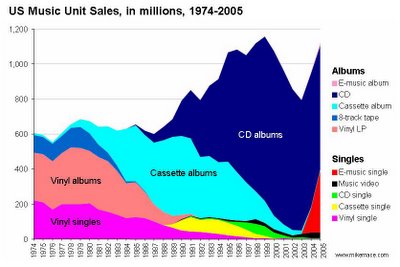
Note that the chart shows unit sales, not revenue. Unit sales are a tricky thing in music – a single and an album each count as one unit. I used units because I couldn't find revenue numbers going back more than a few years. There are pluses and minuses to the units approach, which I'll discuss below.
The most striking thing you can see in the chart is the death and rebirth of the single. In 1974, singles were about a third of music unit sales, but by 2003 that share had dwindled to about 4%. That means music revenue grew much faster in the 1980s and 1990s than what you see in the chart, because customers moved from singles to more expensive albums.
Singles in a music store are a terrible buy today – a typical single on Amazon.com costs about $7-$10, and an album costs about $14. You might as well buy the album. And sure enough, most people do; about 97% of unit sales through retail are albums. The situation is reversed for e-music. On iTunes, a single costs 99 cents and an album costs about $10. Guess what, about 90% of iTunes unit sales are singles.
The big red triangle at the lower right-hand edge of the chart shows the impact of that online pricing structure. The triangle represents unit sales of e-music singles, primarily iTunes (Apple has about 70% to 83% of the US music download market, depending on which source you believe). iTunes and other online paid downloads raised the share of singles to about 25% of US unit sales in 2005, or about 353 million singles.
You can't see this in the chart, but revenue is not growing nearly as fast as units, because online singles are so much cheaper than CD albums. Rolling Stone even called 2005 the music industry's "worst ever." I guess they were thinking about musicians and record companies; music consumers had a fantastic year.
Are e-music sales still growing? A deeply pessimistic article by Bloomberg in November 2005 claimed that iTunes sales stopped growing in the summer of 2005. That drove a lot of pessimistic discussion in music industry circles, and let to a lot of criticism of Apple. If e-music has stopped growing, that would have very enormous implications for the industry, so I tried to figure out what's really happening.
Apple doesn't give clear, regular reports on iTunes music sales. It occasionally issues a press release when it hits a milestone (100m songs sold, etc), and in its quarterly financials it reports a revenue figure for the iTunes store. But that number includes revenue from sales of iPod accessories, which are pretty large. You have to find a way to remove the accessory numbers. Here's what how I did that:
In Apple's fiscal first quarter of 2006 (the three months ending December 2005), it reported iTunes revenue of $491 million. Steve Jobs said at Macworld that the company was selling three million songs a day. That would produce revenue of about $273 million. So the iTunes revenue figure that Apple reports is about 56% songs and 44% accessories.
I went to Apple's previous financial reports, extracted the iTunes revenue numbers, and applied the 56% figure to them. The resulting estimate of iTunes unit sales matched up nicely with Apple's press releases on song sales, so I'm confident that the chart you see below is roughly accurate:
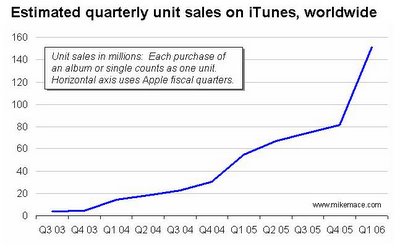
As you can see, Bloomberg was spectacularly wrong -- iTunes unit sales continue to grow quickly. Why did Bloomberg get it wrong? I suspect they made the mistake of looking at quarter to quarter numbers during the summer, when consumer electronics sales almost always stagnate. Sales then explode over the Christmas period. In consumer electronics, you always have to look at year over year comparisons, not quarter to quarter.
iTunes: The Creature that Ate Motown. Setting aside the growth rate, the raw numbers themselves are pretty astounding to me. iTunes alone probably accounts for about one in every five music purchases in the United States right now, and it's continuing to grow.
I think the impact of iTunes has been understated by analysts and the press. In November of 2005, NPD issued a report saying that iTunes had jumped into the top ten US music resellers, at number seven (above Tower Records and below Circuit City). But to calculate its figures, NPD divided iTunes' unit sales by 12, to account for the fact that most iTunes sales are singles. That's appropriate if you're looking at revenue, but I think the total number of transactions is still very meaningful – it speaks to the general amount of business you're driving, and the number of people you're touching.
Think about it: if NPD had counted transactions, iTunes would have tied with Wal-Mart (20% of US music sales) as the largest music store in the United States. Considering its current growth rate, iTunes is certain to become the largest unit seller of music in the US in 2006.
People talk about iTunes as if it's an early stage business, and they discuss all the rival e-music stores as if they're all on the same level as Apple. I'm starting to think that the real question is whether iTunes has already reached a position of unassailable dominance in e-music. I don't know if anyone else in the US can develop enough momentum fast enough to overcome what Apple's doing.
There are hints that Microsoft might try, though. A recent BusinessWeek article reports that Microsoft is considering building an iPod competitor, although the hints in the article make it sound more like a PSP wannabe. Microsoft has enough financial muscle to challenge Apple, but I don't know if it has the system design skills. Maybe it knows enough, though -- all it has to do is imitate Apple, and Microsoft certainly knows how to do that...
Why did CD sales drop after 2000? There's another important point to notice in the chart. Check out the decline in total music unit sales from 2000 to 2003. This is what has the music industry so concerned about Internet piracy, which some people assume is the cause of the decline. Because albums cost more than singles, the decline actually had a larger impact on industry revenue than the chart shows. Personally, I'm sure file sharing is part of the cause. But there are a lot of other explanations as well:
--The Economist claims an internal study conducted by one of the major record companies found that only 1/3 of the drop was attributable to online piracy, with much of the blame instead going to piracy of CDs and especially to the failure of the music companies to promote interesting new music.
--A study by professors at Harvard and the University of North Carolina could find no correlation between online music downloads and reduced sales of CDs. Other studies did find a correlation. This is one of those cases where you can pick the data that matches your preconceptions.
--Some interesting charts here and here argue that the economic downturn in 2001 and rising album prices may have been at fault. The author also points out that record companies dramatically cut their new music releases in the years that sales declined. I'm not sure whether that was a cause or an effect of the sales drop, but at minimum it probably steepened the decline.
--Even some record industry execs say the decline is due in part to rising competition from other forms of entertainment, like DVDs and video games.
Whatever the cause of the album sales slowdown in the past, I think what's happening today is crystal clear: Online singles are replacing CD albums. Unless you're dying to get a full album or you're a stickler for sound quality, there's a huge financial penalty for buying music on a CD today. As that fact sinks into the minds of consumers, music downloads are almost certain to continue to grow.
Welcome to the rabbit hole, Alice
That was the straightforward part of the post. Now things get tricky. Even with the growth of e-music, the record companies are still in charge today. Most musicians are still selling through music publishers whe keep most of the revenue; the artists and record companies are just splitting a smaller pie. I wanted to calculate the tipping point, the point at which it's more profitable for a musician to sell directly through iTunes and other online stores rather than going through a record company. Bear with me while a poli sci major tries to do math...
First, let's look at the economics of music today. If you record a hit song, you'll get less than 15% of the money that people pay to buy it. Maybe you'll get less than 2%. The New York Daily News did a nice case study of what happens to the money when a group creates an album that goes gold. Their fictional rock group, Grunthead, produces a record that brings in $8.49 million. The record company and distribution channels take about 85% of that off the top, and give 15% to the group. But then there are additional charges to produce the album, plus legal and agent fees. These reduce the band members' income to just $161,909 – 1.9% of revenue.
By the way, this assumes the band wrote all its own songs. If the songs were composed by someone else, the musicians would end up roughly splitting their cut with the composer.
The economics could be very different if you sold your music directly through iTunes. Apple keeps 35% of the money paid for a song, and passes along the other 65%. Performers don't get that cut today, of course – the record company takes it. The performers generally get 10-12% of revenue, about the same as what they get from a CD sold in a store. It's fascinating to me that the artists don't get a higher percentage of e-music revenue, even though electronic distribution eliminates the whole physical distribution chain, with its production expenses, shipping costs, retail overhead, and inventory challenges. This point has been made by some very angry websites.
Anyway, if you bypass the record company you can keep the whole 65% for yourself. This makes the preliminary calculation easy – it pays to bypass the record company when e-music accounts for more than about 16% of total unit sales of music. Even though you lose a ton of CD sales, you make up the loss because you're making so much more per online sale.
But it's not that simple, because unit sales on iTunes are 90% made up of 99-cent singles, whereas in a record store they are almost all $14 albums. I don't think this is just because people go to iTunes when they want to buy singles; I think iTunes turns people into singles buyers. So the economics gets very skunky for a current musical act. If you're selling through a record company today, you get about $2.10 per album sold (15% of $14). If you switch to iTunes, and 90% of your unit sales convert to singles, you'll get an average of about $1.23 per unit that you sell (65 cents per single plus $6.50 per album). You could actually lose money per unit by going to e-music, because you trade customers down from albums to singles. Presumably you'll sell more singles because they're cheaper, and because your fans might want more than one song from your album. But I don't know how big the uplift would be, and I seriously doubt it would overcome the reduced price per unit.
In this situation, it doesn't pay to go independent until e-music accounts for more than 63% of total music unit sales. Given the rate at which iTunes is growing, that could theoretically happen by the end of the decade – but counting on exponential growth to continue for several years is one of the dumbest things you can do in high tech. So the tipping point is probably even further off.
A new hope
The easiest way to bring the tipping point substantially closer is to charge more than 99 cents for an online single. For example, if you could sell your song online for $2.99, you would make more money selling on your own as soon as e-music sales reach about 47% of total music unit sales. Considering that e-music already has 25% unit share in the US, I think 47% might be achievable in the next two to three years.
It's ironic. The record companies have been campaigning loudly for the right to charge more than 99 cents per song, so they can make more money. But if they get their way, all they'll do is facilitate their own extinction.
Be very careful what you wish for.
I'm oversimplifying
The real situation is much more complex than what I've described above. You can make yourself nuts with the permutations. For example:
The effect of price changes is unpredictable. Changing the relative prices of singles and albums will alter the sales mix in ways no one can anticipate today. That might bring the tipping point closer, or push it further away. Also, if the price of online singles goes up too much, teenagers might go back to stealing music. Then the artists and the record companies would both starve, but the lawyers would get rich.
I assumed one single would substitute for one album. If people bought two e-music singles for every CD album that gets cannibalized, the threshold for the tipping point would be years closer. Does the average album has more than one best-selling song on it/ I'll let you judge.
The whole concept of singles and albums could melt away. An interesting essay in the Guardian pointed out that the single was constrained by the amount of music you can fit on a vinyl disk rotating 45 times a minute. The three-minute format is still useful for radio and music videos, but there's no reason that a downloaded song can't be 30 seconds long or twenty minutes long. The main limitation is our own assumptions.
Also, if a music group didn't have to focus on making albums, it might be able to spend more time crafting a smaller number of truly great songs. That would improve the overall quality of popular music, even if the total number of songs being written went down.
All the more reason for Apple to allow variable pricing.
Wireless sales to mobile phones are a wild card. The record companies are starting to get significant money from ringtones. (Supposedly revenue from them was 40% of total e-music revenue last year. The unit volume would be less than 40% because ringtones often cost more than 99 cents.) It's hard for an independent artist to sell ringtones because you have to go through mobile operator contracts, something that a big record company can negotiate much more easily. This might strengthen the record companies. On the other hand, as more phones develop MP3 ringtone capability, maybe more customers will start installing their own ringtones and bypass the operators. On the other other hand, maybe the operators will disable MP3 playback in the phones they sell. Good luck mapping out what'll happen here.
All of this is analysis is US-only. The development of the music market will probably be dramatically different in other countries, where PCs (and PC-based music downloading) are less popular, and people may be more interested in downloading music directly to a mobile phone. The wireless operators certainly hope that's what'll happen. The IFPI report on music sales in 2005 says that music downloading to PCs is dominant in the US, UK and Germany, while Italy, France, and Japan are strong in downloading to mobile phones (iTunes didn't even launch in Japan until June of 2005).
The impact of music subscription services is unclear. Then there are the subscription music companies like Real Networks' Rhapsody Unlimited and Yahoo's Music Unlimited. Steve Jobs has a funny quote about them: "I think you could make available the Second Coming in a subscription model and it might not be successful." I share some of his skepticism – to me, the idea of losing access to my music when I stop subscribing feels like blackmail. But on the other hand I know one of the senior guys in the music business at Real. He's wickedly smart, and I don't think he'd chase a useless idea. I haven't had a chance to do independent customer research on this subject, and it's possible that I'm just out of touch with how customers will behave, especially people younger than me.
The pricing structure for a music subscription service is completely different from a store like iTunes. To use Real's Rhapsody Unlimited for a year, you pay $120 and you can listen to all the music you want. If you want to keep listening to music, you have to pay again every year. Let's assume the case of a 20-year-old who lives until age 80. Over her lifetime, she'll pay $7,200 for music services.
That same investment in the iTunes music store would buy 7,272 singles, or one new song every three days for her entire life (for comparison, the average iTunes user today buys about three songs a month). For all but the most aggressive music users, a music subscription is a lot more expensive over your lifetime than buying songs – as long as you're thinking ahead 60 years. It's not clear that everyone does.
The situation gets more confusing when you look at the royalties for music used on subscription services. Believe it or not, no one knows what the royalties will be. The music industry and the subscription services have spent the last four years negotiating the issue, and they're still far apart. In the meantime, interim royalties are being paid into a holding fund; the musicians aren't being paid at all. The subscription companies want to pay 6.9% of their revenue in royalties, and the music companies want 14%. Even at that 14% figure, the lifetime royalty income from our 80-year-old-user would be only $1,008. The same user buying 7,272 singles on iTunes (even at just 99 cents a song) would produce royalties of about $4,700.
For music publishers and performers, selling songs is vastly more lucrative because they get a much bigger cut of the revenue. They have a strong incentive to see the subscription services fail.
No wonder the negotiations are so bitter. And no wonder Steve Jobs is so caustic toward the rental services – they get much higher margins than he does.
The negotiations may have to be decided by (brace yourself) the US Congress. There's no way to tell what Congress will do, and so there's no way today to tell if the subscription services will bring the tipping point closer or push it further away.
It's enough to make a person long for the "simple" days of vinyl records.
What will happen?
Anyone who tells you they know for sure what will happen to the music business is either delusional or selling something; the variables are too numerous and complex to make high-confidence predictions. But since I raised the subject here, I feel obligated to put a stake in the ground. So here's my guess:
Apple will eventually allow variable pricing on singles. That change has been slowed by New York state's investigation of the record companies for online song price-fixing. According to the LA Times, the focus of the investigation is on "most favored nation" clauses in which record company contracts mandated that they get the highest price for singles charged by any other record company. That would have the effect of jacking up prices automatically, the sort of thing the government frowns on. But the basic idea of a store charging more than 99 cents is apparently not at issue, and indeed some wireless music stores already do. So I believe that after holding out for another year or so to help solidify its dominance, Apple will eventually give in. The price of an online single will then settle at a balancing point that produces the most revenue without driving an explosion of piracy. I suspect (gut instinct here) that point is about $1.99 per song for current releases.
The move to variable pricing is essential to drive the economics of the tipping point, so I hope Apple will get on with it.
The tipping point will arrive in 2008 or 2009. Even if you can charge $2 a copy for an e-single, the financial case for an existing act to dump its record label and sell direct is difficult, because a current group needs to protect the revenue it gets from CD sales. But a newly-formed group doesn't have existing sales to protect, and it has the most to gain from the lower barriers to entry in online sales. I think the tipping point will come the first time a new music act, selling online, is able to make serious money from a hit single, without ever bothering to create an album, burn a CD, or sign with a record company. That example will incent a new generation of performers to bypass the record companies. Their critical mass of fresh talent will drive up e-music sales further, producing a self-reinforcing transition away from record industry control. Another gut guess: I think we'll hit the tipping point when you can sell a single on iTunes for $1.99, and when US e-music unit sales hit about a third of total music sales. If current growth continues (always a dangerous assumption), the tipping point could come in 2008. Call it 2009 if you want to be conservative.
When that day comes, I suspect that Steve Jobs will be there with a Mac-based music editing program that has a "publish" button in it. Press the button, and your song is automatically uploaded to iTunes.
Parts of the record industry that add value will survive indefinitely. Some people will continue to want CDs -- either for nostalgia or because, for the time being, CDs have higher sound quality. Even in the e-music space there will still be roles for business managers who discover new artists and help them market, producers who improve the quality of their music, and concert promoters.
The number of independent record stores will continue to decline. This has almost nothing to do with online music; it's being driven by competition from the mass retailers like Wal-Mart (the #1 US music chain in album sales), Target (#3), and Amazon (#4). They skim off the most popular titles and sell them for aggressive prices, gutting the margins of the record stores (the same thing is happening to independent toy stores). E-music will at most just accelerate this trend.
Can anyone stop the iPod?
No.
The time to stop it was two years ago. At this point the real question is whether anyone in the US can even keep up. The iPod is a system that includes both an online service and devices, and I think the only way to compete will be with full systems. Few companies with a presence in the US have both the skills and resources to do that. Microsoft can. Nokia can. Google and maybe Yahoo can. A stock analyst claimed in January that Google is planning a music store . Almost everyone in Silicon Valley would enjoy watching an Apple-Microsoft-Google cage match, but I think Google will be the first one hit in the head by a folding chair unless it also makes the devices.
Outside the US, the picture's much less clear. There aren't a lot of systems-oriented tech companies anywhere, but iTunes is much less established in many other countries, so there may still be time for smaller companies to make a play. In Japan, I would never bet against the two leading operators, NTT DoCoMo and KDDI.
The new powers in the industry will be the big online music stores. By featuring particular artists, they'll be able to make careers. Which e-music stores are likely to be dominant? In the US, Apple has a big lead in sales and an enormous lead in momentum. I dearly hope they won't be the single dominant store – if there's effective competition, it'll keep music prices low, give more of the rewards directly to artists, and make it easier for new acts to break into the industry. And that's the outcome that would make this whole complicated, painful transition worthwhile.
That's my take on things. What do you think? Do you have fixes to my analysis? Disagree with my conclusions? Please leave a comment – I'm interested in your perspective.
Next in Removing the Middleman: ebooks. And you thought music was complicated.
________________
*The music sales chart is based on figures from the RIAA (a music industry trade group), Rolling Stone, IFPI (another music industry trade group), and numbers extracted from a nifty historical chart prepared by Karl Hartig.
More info:
An organization called Future of Music Coalition has done a lot of analysis of music economics, from the perspective of an artist. I think it's very rational stuff, and a nice counterpoint to the strong rhetoric you hear from the tech companies on one side and the record companies on the other. I thought their analysis of iTunes was especially good. Highly recommended.
IFPI's report on global music downloads is interesting, even though it reads like it was written by a PR agency. It has some interesting tidbits on what's happening outside the US.
The Economist did a nice overview of the music industry.
There's a book and weblog called The Future of Music that talks about many of these issues. The authors have been in the music industry for years, and some of their conclusions are very different from mine. Check them out and you can make up your own mind. Also, I want to give them credit for pointing out the Rolling Stone quote that I used at the start of this post.
--Rolling Stone Magazine, January 13 2006
Most people agree that the Internet and technology changes will make it possible to replace the pipe companies – the carriers, publishers, and networks that deliver the world's information, entertainment, and communication. But that change has been predicted for years. Will it really happen? If so, when? And what business and technology infrastructure needs to be created first?
In Part One, I gave an overview of the situation. This time let's look in depth at the music industry. I'll start with a summary and then explain how I got there.
Summary: E-music changes the world in unexpected ways
--I think the biggest change happening in music distribution right now isn't piracy, it's cannibalization of CD albums by e-music singles.
--I can't believe I'm saying this, but despite all the hype, the iTunes music store is actually much more powerful than most people realize. I think it may already be too late for any competitor to stop iTunes from becoming the dominant music store in the US.
--The tipping point at which the record companies will become obsolete may arrive in about two years.
--The record companies think that variable pricing for an online single will increase their profits, but the main effect will actually be to bring the tipping point closer.
I thought this was going to be an easy post to write, but I was wrong. Every time I thought I was finished, I found major new pieces of information that forced me to go back and re-write. The situation's complicated enough that I'm still not sure I got everything right. So I'll be very interested in your comments. Before we talk about where the industry's going, we need to discuss where it is now...
The music industry today
It's surprisingly hard to get clear data on what's happening in the music industry. Conditions are changing quickly, and the industry has some interesting counting practices that can easily confuse you unless you look at them very carefully. Below is the best chart I could create of music sales in the US (sorry, I couldn't find complete worldwide data). The chart shows US music unit sales by media type, from 1974 to 2005.*
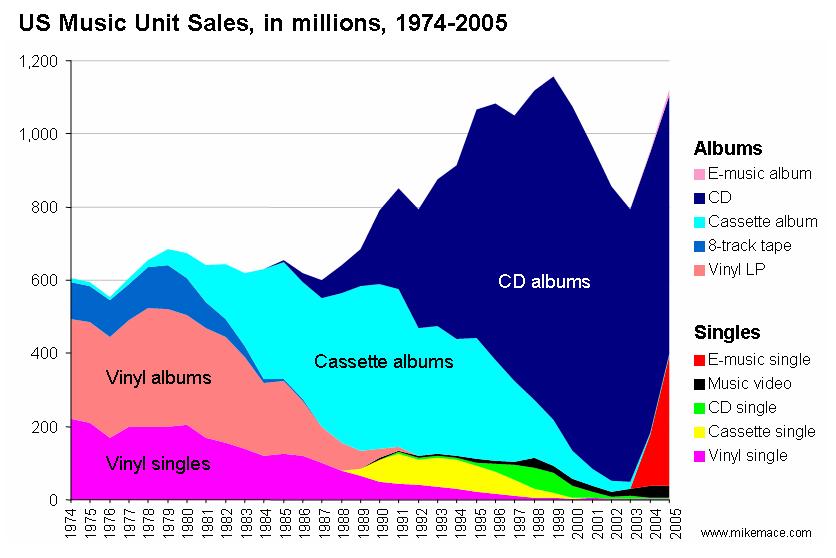
Note that the chart shows unit sales, not revenue. Unit sales are a tricky thing in music – a single and an album each count as one unit. I used units because I couldn't find revenue numbers going back more than a few years. There are pluses and minuses to the units approach, which I'll discuss below.
The most striking thing you can see in the chart is the death and rebirth of the single. In 1974, singles were about a third of music unit sales, but by 2003 that share had dwindled to about 4%. That means music revenue grew much faster in the 1980s and 1990s than what you see in the chart, because customers moved from singles to more expensive albums.
Singles in a music store are a terrible buy today – a typical single on Amazon.com costs about $7-$10, and an album costs about $14. You might as well buy the album. And sure enough, most people do; about 97% of unit sales through retail are albums. The situation is reversed for e-music. On iTunes, a single costs 99 cents and an album costs about $10. Guess what, about 90% of iTunes unit sales are singles.
The big red triangle at the lower right-hand edge of the chart shows the impact of that online pricing structure. The triangle represents unit sales of e-music singles, primarily iTunes (Apple has about 70% to 83% of the US music download market, depending on which source you believe). iTunes and other online paid downloads raised the share of singles to about 25% of US unit sales in 2005, or about 353 million singles.
You can't see this in the chart, but revenue is not growing nearly as fast as units, because online singles are so much cheaper than CD albums. Rolling Stone even called 2005 the music industry's "worst ever." I guess they were thinking about musicians and record companies; music consumers had a fantastic year.
Are e-music sales still growing? A deeply pessimistic article by Bloomberg in November 2005 claimed that iTunes sales stopped growing in the summer of 2005. That drove a lot of pessimistic discussion in music industry circles, and let to a lot of criticism of Apple. If e-music has stopped growing, that would have very enormous implications for the industry, so I tried to figure out what's really happening.
Apple doesn't give clear, regular reports on iTunes music sales. It occasionally issues a press release when it hits a milestone (100m songs sold, etc), and in its quarterly financials it reports a revenue figure for the iTunes store. But that number includes revenue from sales of iPod accessories, which are pretty large. You have to find a way to remove the accessory numbers. Here's what how I did that:
In Apple's fiscal first quarter of 2006 (the three months ending December 2005), it reported iTunes revenue of $491 million. Steve Jobs said at Macworld that the company was selling three million songs a day. That would produce revenue of about $273 million. So the iTunes revenue figure that Apple reports is about 56% songs and 44% accessories.
I went to Apple's previous financial reports, extracted the iTunes revenue numbers, and applied the 56% figure to them. The resulting estimate of iTunes unit sales matched up nicely with Apple's press releases on song sales, so I'm confident that the chart you see below is roughly accurate:

As you can see, Bloomberg was spectacularly wrong -- iTunes unit sales continue to grow quickly. Why did Bloomberg get it wrong? I suspect they made the mistake of looking at quarter to quarter numbers during the summer, when consumer electronics sales almost always stagnate. Sales then explode over the Christmas period. In consumer electronics, you always have to look at year over year comparisons, not quarter to quarter.
iTunes: The Creature that Ate Motown. Setting aside the growth rate, the raw numbers themselves are pretty astounding to me. iTunes alone probably accounts for about one in every five music purchases in the United States right now, and it's continuing to grow.
I think the impact of iTunes has been understated by analysts and the press. In November of 2005, NPD issued a report saying that iTunes had jumped into the top ten US music resellers, at number seven (above Tower Records and below Circuit City). But to calculate its figures, NPD divided iTunes' unit sales by 12, to account for the fact that most iTunes sales are singles. That's appropriate if you're looking at revenue, but I think the total number of transactions is still very meaningful – it speaks to the general amount of business you're driving, and the number of people you're touching.
Think about it: if NPD had counted transactions, iTunes would have tied with Wal-Mart (20% of US music sales) as the largest music store in the United States. Considering its current growth rate, iTunes is certain to become the largest unit seller of music in the US in 2006.
People talk about iTunes as if it's an early stage business, and they discuss all the rival e-music stores as if they're all on the same level as Apple. I'm starting to think that the real question is whether iTunes has already reached a position of unassailable dominance in e-music. I don't know if anyone else in the US can develop enough momentum fast enough to overcome what Apple's doing.
There are hints that Microsoft might try, though. A recent BusinessWeek article reports that Microsoft is considering building an iPod competitor, although the hints in the article make it sound more like a PSP wannabe. Microsoft has enough financial muscle to challenge Apple, but I don't know if it has the system design skills. Maybe it knows enough, though -- all it has to do is imitate Apple, and Microsoft certainly knows how to do that...
Why did CD sales drop after 2000? There's another important point to notice in the chart. Check out the decline in total music unit sales from 2000 to 2003. This is what has the music industry so concerned about Internet piracy, which some people assume is the cause of the decline. Because albums cost more than singles, the decline actually had a larger impact on industry revenue than the chart shows. Personally, I'm sure file sharing is part of the cause. But there are a lot of other explanations as well:
--The Economist claims an internal study conducted by one of the major record companies found that only 1/3 of the drop was attributable to online piracy, with much of the blame instead going to piracy of CDs and especially to the failure of the music companies to promote interesting new music.
--A study by professors at Harvard and the University of North Carolina could find no correlation between online music downloads and reduced sales of CDs. Other studies did find a correlation. This is one of those cases where you can pick the data that matches your preconceptions.
--Some interesting charts here and here argue that the economic downturn in 2001 and rising album prices may have been at fault. The author also points out that record companies dramatically cut their new music releases in the years that sales declined. I'm not sure whether that was a cause or an effect of the sales drop, but at minimum it probably steepened the decline.
--Even some record industry execs say the decline is due in part to rising competition from other forms of entertainment, like DVDs and video games.
Whatever the cause of the album sales slowdown in the past, I think what's happening today is crystal clear: Online singles are replacing CD albums. Unless you're dying to get a full album or you're a stickler for sound quality, there's a huge financial penalty for buying music on a CD today. As that fact sinks into the minds of consumers, music downloads are almost certain to continue to grow.
Welcome to the rabbit hole, Alice
That was the straightforward part of the post. Now things get tricky. Even with the growth of e-music, the record companies are still in charge today. Most musicians are still selling through music publishers whe keep most of the revenue; the artists and record companies are just splitting a smaller pie. I wanted to calculate the tipping point, the point at which it's more profitable for a musician to sell directly through iTunes and other online stores rather than going through a record company. Bear with me while a poli sci major tries to do math...
First, let's look at the economics of music today. If you record a hit song, you'll get less than 15% of the money that people pay to buy it. Maybe you'll get less than 2%. The New York Daily News did a nice case study of what happens to the money when a group creates an album that goes gold. Their fictional rock group, Grunthead, produces a record that brings in $8.49 million. The record company and distribution channels take about 85% of that off the top, and give 15% to the group. But then there are additional charges to produce the album, plus legal and agent fees. These reduce the band members' income to just $161,909 – 1.9% of revenue.
By the way, this assumes the band wrote all its own songs. If the songs were composed by someone else, the musicians would end up roughly splitting their cut with the composer.
The economics could be very different if you sold your music directly through iTunes. Apple keeps 35% of the money paid for a song, and passes along the other 65%. Performers don't get that cut today, of course – the record company takes it. The performers generally get 10-12% of revenue, about the same as what they get from a CD sold in a store. It's fascinating to me that the artists don't get a higher percentage of e-music revenue, even though electronic distribution eliminates the whole physical distribution chain, with its production expenses, shipping costs, retail overhead, and inventory challenges. This point has been made by some very angry websites.
Anyway, if you bypass the record company you can keep the whole 65% for yourself. This makes the preliminary calculation easy – it pays to bypass the record company when e-music accounts for more than about 16% of total unit sales of music. Even though you lose a ton of CD sales, you make up the loss because you're making so much more per online sale.
But it's not that simple, because unit sales on iTunes are 90% made up of 99-cent singles, whereas in a record store they are almost all $14 albums. I don't think this is just because people go to iTunes when they want to buy singles; I think iTunes turns people into singles buyers. So the economics gets very skunky for a current musical act. If you're selling through a record company today, you get about $2.10 per album sold (15% of $14). If you switch to iTunes, and 90% of your unit sales convert to singles, you'll get an average of about $1.23 per unit that you sell (65 cents per single plus $6.50 per album). You could actually lose money per unit by going to e-music, because you trade customers down from albums to singles. Presumably you'll sell more singles because they're cheaper, and because your fans might want more than one song from your album. But I don't know how big the uplift would be, and I seriously doubt it would overcome the reduced price per unit.
In this situation, it doesn't pay to go independent until e-music accounts for more than 63% of total music unit sales. Given the rate at which iTunes is growing, that could theoretically happen by the end of the decade – but counting on exponential growth to continue for several years is one of the dumbest things you can do in high tech. So the tipping point is probably even further off.
A new hope
The easiest way to bring the tipping point substantially closer is to charge more than 99 cents for an online single. For example, if you could sell your song online for $2.99, you would make more money selling on your own as soon as e-music sales reach about 47% of total music unit sales. Considering that e-music already has 25% unit share in the US, I think 47% might be achievable in the next two to three years.
It's ironic. The record companies have been campaigning loudly for the right to charge more than 99 cents per song, so they can make more money. But if they get their way, all they'll do is facilitate their own extinction.
Be very careful what you wish for.
I'm oversimplifying
The real situation is much more complex than what I've described above. You can make yourself nuts with the permutations. For example:
The effect of price changes is unpredictable. Changing the relative prices of singles and albums will alter the sales mix in ways no one can anticipate today. That might bring the tipping point closer, or push it further away. Also, if the price of online singles goes up too much, teenagers might go back to stealing music. Then the artists and the record companies would both starve, but the lawyers would get rich.
I assumed one single would substitute for one album. If people bought two e-music singles for every CD album that gets cannibalized, the threshold for the tipping point would be years closer. Does the average album has more than one best-selling song on it/ I'll let you judge.
The whole concept of singles and albums could melt away. An interesting essay in the Guardian pointed out that the single was constrained by the amount of music you can fit on a vinyl disk rotating 45 times a minute. The three-minute format is still useful for radio and music videos, but there's no reason that a downloaded song can't be 30 seconds long or twenty minutes long. The main limitation is our own assumptions.
Also, if a music group didn't have to focus on making albums, it might be able to spend more time crafting a smaller number of truly great songs. That would improve the overall quality of popular music, even if the total number of songs being written went down.
All the more reason for Apple to allow variable pricing.
Wireless sales to mobile phones are a wild card. The record companies are starting to get significant money from ringtones. (Supposedly revenue from them was 40% of total e-music revenue last year. The unit volume would be less than 40% because ringtones often cost more than 99 cents.) It's hard for an independent artist to sell ringtones because you have to go through mobile operator contracts, something that a big record company can negotiate much more easily. This might strengthen the record companies. On the other hand, as more phones develop MP3 ringtone capability, maybe more customers will start installing their own ringtones and bypass the operators. On the other other hand, maybe the operators will disable MP3 playback in the phones they sell. Good luck mapping out what'll happen here.
All of this is analysis is US-only. The development of the music market will probably be dramatically different in other countries, where PCs (and PC-based music downloading) are less popular, and people may be more interested in downloading music directly to a mobile phone. The wireless operators certainly hope that's what'll happen. The IFPI report on music sales in 2005 says that music downloading to PCs is dominant in the US, UK and Germany, while Italy, France, and Japan are strong in downloading to mobile phones (iTunes didn't even launch in Japan until June of 2005).
The impact of music subscription services is unclear. Then there are the subscription music companies like Real Networks' Rhapsody Unlimited and Yahoo's Music Unlimited. Steve Jobs has a funny quote about them: "I think you could make available the Second Coming in a subscription model and it might not be successful." I share some of his skepticism – to me, the idea of losing access to my music when I stop subscribing feels like blackmail. But on the other hand I know one of the senior guys in the music business at Real. He's wickedly smart, and I don't think he'd chase a useless idea. I haven't had a chance to do independent customer research on this subject, and it's possible that I'm just out of touch with how customers will behave, especially people younger than me.
The pricing structure for a music subscription service is completely different from a store like iTunes. To use Real's Rhapsody Unlimited for a year, you pay $120 and you can listen to all the music you want. If you want to keep listening to music, you have to pay again every year. Let's assume the case of a 20-year-old who lives until age 80. Over her lifetime, she'll pay $7,200 for music services.
That same investment in the iTunes music store would buy 7,272 singles, or one new song every three days for her entire life (for comparison, the average iTunes user today buys about three songs a month). For all but the most aggressive music users, a music subscription is a lot more expensive over your lifetime than buying songs – as long as you're thinking ahead 60 years. It's not clear that everyone does.
The situation gets more confusing when you look at the royalties for music used on subscription services. Believe it or not, no one knows what the royalties will be. The music industry and the subscription services have spent the last four years negotiating the issue, and they're still far apart. In the meantime, interim royalties are being paid into a holding fund; the musicians aren't being paid at all. The subscription companies want to pay 6.9% of their revenue in royalties, and the music companies want 14%. Even at that 14% figure, the lifetime royalty income from our 80-year-old-user would be only $1,008. The same user buying 7,272 singles on iTunes (even at just 99 cents a song) would produce royalties of about $4,700.
For music publishers and performers, selling songs is vastly more lucrative because they get a much bigger cut of the revenue. They have a strong incentive to see the subscription services fail.
No wonder the negotiations are so bitter. And no wonder Steve Jobs is so caustic toward the rental services – they get much higher margins than he does.
The negotiations may have to be decided by (brace yourself) the US Congress. There's no way to tell what Congress will do, and so there's no way today to tell if the subscription services will bring the tipping point closer or push it further away.
It's enough to make a person long for the "simple" days of vinyl records.
What will happen?
Anyone who tells you they know for sure what will happen to the music business is either delusional or selling something; the variables are too numerous and complex to make high-confidence predictions. But since I raised the subject here, I feel obligated to put a stake in the ground. So here's my guess:
Apple will eventually allow variable pricing on singles. That change has been slowed by New York state's investigation of the record companies for online song price-fixing. According to the LA Times, the focus of the investigation is on "most favored nation" clauses in which record company contracts mandated that they get the highest price for singles charged by any other record company. That would have the effect of jacking up prices automatically, the sort of thing the government frowns on. But the basic idea of a store charging more than 99 cents is apparently not at issue, and indeed some wireless music stores already do. So I believe that after holding out for another year or so to help solidify its dominance, Apple will eventually give in. The price of an online single will then settle at a balancing point that produces the most revenue without driving an explosion of piracy. I suspect (gut instinct here) that point is about $1.99 per song for current releases.
The move to variable pricing is essential to drive the economics of the tipping point, so I hope Apple will get on with it.
The tipping point will arrive in 2008 or 2009. Even if you can charge $2 a copy for an e-single, the financial case for an existing act to dump its record label and sell direct is difficult, because a current group needs to protect the revenue it gets from CD sales. But a newly-formed group doesn't have existing sales to protect, and it has the most to gain from the lower barriers to entry in online sales. I think the tipping point will come the first time a new music act, selling online, is able to make serious money from a hit single, without ever bothering to create an album, burn a CD, or sign with a record company. That example will incent a new generation of performers to bypass the record companies. Their critical mass of fresh talent will drive up e-music sales further, producing a self-reinforcing transition away from record industry control. Another gut guess: I think we'll hit the tipping point when you can sell a single on iTunes for $1.99, and when US e-music unit sales hit about a third of total music sales. If current growth continues (always a dangerous assumption), the tipping point could come in 2008. Call it 2009 if you want to be conservative.
When that day comes, I suspect that Steve Jobs will be there with a Mac-based music editing program that has a "publish" button in it. Press the button, and your song is automatically uploaded to iTunes.
Parts of the record industry that add value will survive indefinitely. Some people will continue to want CDs -- either for nostalgia or because, for the time being, CDs have higher sound quality. Even in the e-music space there will still be roles for business managers who discover new artists and help them market, producers who improve the quality of their music, and concert promoters.
The number of independent record stores will continue to decline. This has almost nothing to do with online music; it's being driven by competition from the mass retailers like Wal-Mart (the #1 US music chain in album sales), Target (#3), and Amazon (#4). They skim off the most popular titles and sell them for aggressive prices, gutting the margins of the record stores (the same thing is happening to independent toy stores). E-music will at most just accelerate this trend.
Can anyone stop the iPod?
No.
The time to stop it was two years ago. At this point the real question is whether anyone in the US can even keep up. The iPod is a system that includes both an online service and devices, and I think the only way to compete will be with full systems. Few companies with a presence in the US have both the skills and resources to do that. Microsoft can. Nokia can. Google and maybe Yahoo can. A stock analyst claimed in January that Google is planning a music store . Almost everyone in Silicon Valley would enjoy watching an Apple-Microsoft-Google cage match, but I think Google will be the first one hit in the head by a folding chair unless it also makes the devices.
Outside the US, the picture's much less clear. There aren't a lot of systems-oriented tech companies anywhere, but iTunes is much less established in many other countries, so there may still be time for smaller companies to make a play. In Japan, I would never bet against the two leading operators, NTT DoCoMo and KDDI.
The new powers in the industry will be the big online music stores. By featuring particular artists, they'll be able to make careers. Which e-music stores are likely to be dominant? In the US, Apple has a big lead in sales and an enormous lead in momentum. I dearly hope they won't be the single dominant store – if there's effective competition, it'll keep music prices low, give more of the rewards directly to artists, and make it easier for new acts to break into the industry. And that's the outcome that would make this whole complicated, painful transition worthwhile.
That's my take on things. What do you think? Do you have fixes to my analysis? Disagree with my conclusions? Please leave a comment – I'm interested in your perspective.
Next in Removing the Middleman: ebooks. And you thought music was complicated.
________________
*The music sales chart is based on figures from the RIAA (a music industry trade group), Rolling Stone, IFPI (another music industry trade group), and numbers extracted from a nifty historical chart prepared by Karl Hartig.
More info:
An organization called Future of Music Coalition has done a lot of analysis of music economics, from the perspective of an artist. I think it's very rational stuff, and a nice counterpoint to the strong rhetoric you hear from the tech companies on one side and the record companies on the other. I thought their analysis of iTunes was especially good. Highly recommended.
IFPI's report on global music downloads is interesting, even though it reads like it was written by a PR agency. It has some interesting tidbits on what's happening outside the US.
The Economist did a nice overview of the music industry.
There's a book and weblog called The Future of Music that talks about many of these issues. The authors have been in the music industry for years, and some of their conclusions are very different from mine. Check them out and you can make up your own mind. Also, I want to give them credit for pointing out the Rolling Stone quote that I used at the start of this post.
Langganan:
Postingan (Atom)